
Product Releases
Sep 30, 2026
How CRE Operators Prove ROI From Building Operations Software
Five steps to go from "it feels valuable" to a business case your buying committee approves.
The terms behind BOMA's measurement standards, defined clearly for the professionals who use them every day
BOMA's value to commercial real estate is its shared language.
The BOMA definition of how space is measured is the foundation that makes leasing terms and expense recoveries comparable across assets and investment portfolios. BOMA square footage measurement standards give CRE teams a consistent framework for calculating BOMA square footage across every asset type, and when those standards are updated, as they have been across nearly every asset class in recent years, it’s important you understand the fine print.
If you have already read our guide to the latest BOMA standard updates across property types, the definitions below will help make sure you follow them to the letter.
These definitions sit behind every lease abstract and operating expense reconciliation across a commercial portfolio, so we thought we’d make them easier to understand.
The BOMA Standard Method of Measurement is the industry-recognized framework that defines how commercial floor area is calculated and reported across asset types. It establishes where measurement lines are drawn, how shared elements like corridors and lobbies are treated, and how space is classified for leasing and valuation purposes. Current editions by asset type:
Usable area is the space a tenant occupies exclusively, before any share of common building spaces is added. Depending on the asset type and lease structure, usable area forms the baseline from which rentable area and load factor calculations follow, making it one of the most referenced measurements in commercial real estate property management.
Rentable area represents a tenant's pro-rata portion of an entire floor, derived by multiplying the usable area by the floor's rentable-to-usable ratio. Once established, it is fixed for the life of the building, meaning corridor reconfigurations and common area adjustments have no effect on it.
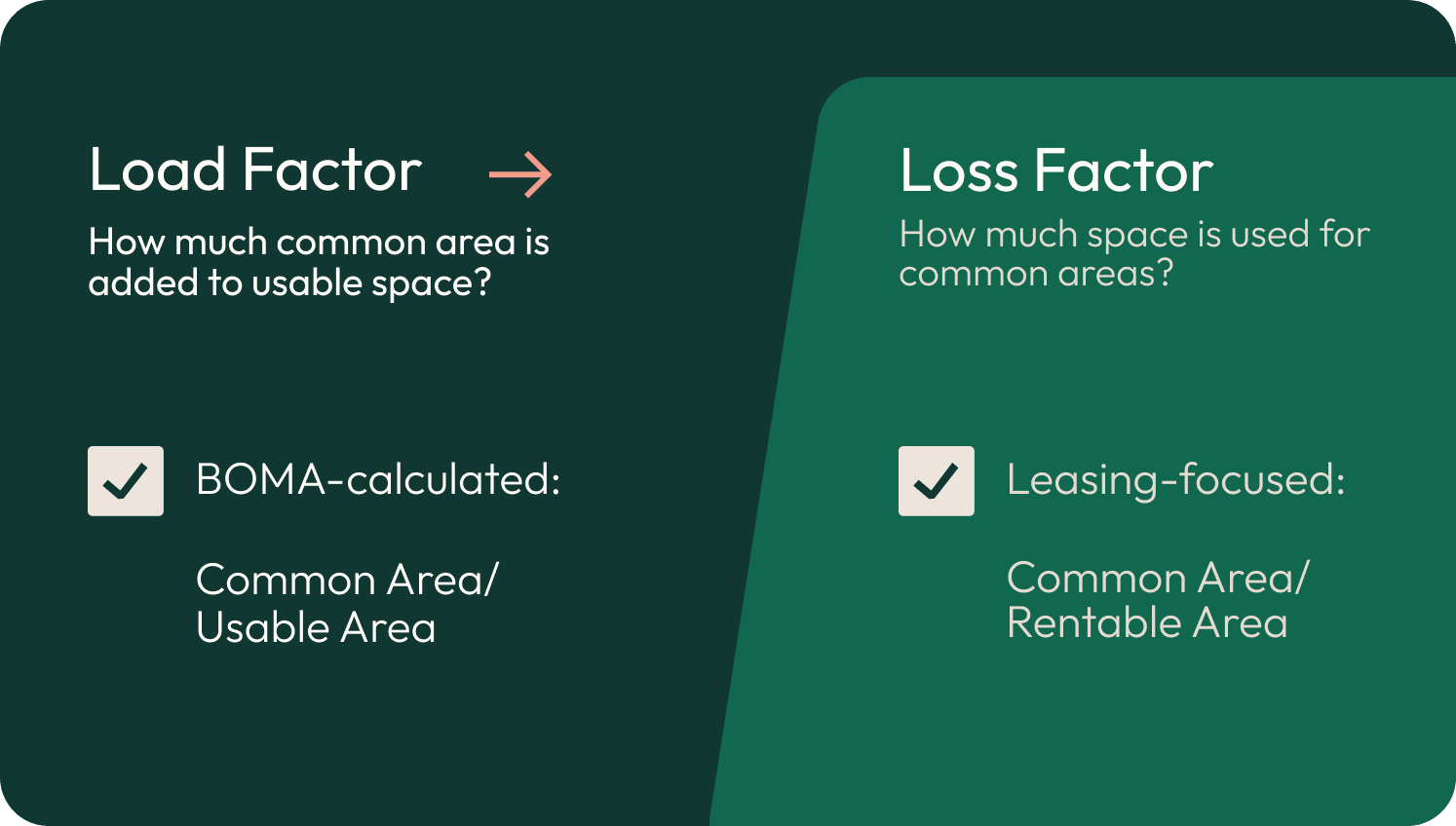
The load factor represents the proportion of common areas allocated to each tenant on top of their exclusive usable area. It combines building service areas like lobbies and mechanical rooms with floor service areas like bathrooms and utility rooms serving a single floor, together determining the total rentable square footage charged to a tenant.
Load factor is often confused with loss factor, but the two come from different frameworks.
Common area maintenance charges, known as CAM charges, are the operating expenses tenants pay proportionately for shared building spaces beyond their rentable area. They typically cover:
Accurate CAM reconciliation depends directly on BOMA-compliant area measurements, since any discrepancy in rentable or usable area flows through to what tenants are billed.
Under BOMA 2024, building amenity areas are shared spaces within a building that support tenant use but are not leased to any single occupant. The standard distinguishes between two types:
Each type carries its own allocation logic, and under BOMA 2024, both run through a single load factor per floor, giving tenants a clearer line of sight into what they are paying for.
Building service areas are the spaces that keep a building running, not occupied by tenants but essential to building operations for everyone in it. These areas are proportionately allocated to all occupants through the load factor.
Examples include:
These are tenant-occupied spaces excluded from the load factor because the load factor exists to distribute common area costs proportionately across multiple occupants on a floor. When a single tenant occupies an entire floor, there are no other occupants to distribute those costs across, making the calculation meaningless. Classifying those areas as non-allocated reflects that reality.
Inter-allocated areas are spaces shared between two or more tenants on the same floor that fall outside the standard BOMA measurement load factor calculation. Rather than being allocated building-wide, their costs are distributed only among the specific tenants who share and benefit from them.
Examples include:
Gross Leasable Area, or GLA, is the total floor area intended for tenant occupancy across retail, industrial, and mixed-use properties.
Building class factors are the criteria BOMA measurements use to group buildings into quality tiers that indicate each asset's competitive ability to attract similar types of tenants. The system exists to standardize how office market conditions are discussed and reported, not to publish ratings for individual properties.
Two frameworks apply: metropolitan, used within a specific office market, and international, used by investors comparing assets across markets.
Metropolitan classes:
International classes:
BOMA definitions give CRE teams a shared language. Putting that language to work across a portfolio requires connecting standardized area data to the operational workflows running every building day to day.
As a BOMA member, Visitt embeds BOMA-aligned area information into facility management records and carries it through commercial property inspections, maintenance planning, leasing, and billing, so the measurement data behind every lease and expense reconciliation stays accurate at the operational level at scale.
If your team is ready to put BOMA-aligned data to work across your portfolio, talk to our team and explore how we can work together.
BOMA stands for the Building Owners and Managers Association. Founded over 100 years ago, it is the leading trade association for commercial real estate professionals and the primary source for building measurement standards used across leasing, valuation, and operations.
BOMA standards are measurement guidelines from the Building Owners and Managers Association that define how commercial floor area is calculated and reported. They establish how usable, rentable, and common areas are classified so valuations affecting investment and leasing terms rest on consistent, comparable data across every asset type.
Usable area is the space a tenant occupies exclusively. Rentable area adds a proportionate share of common spaces like lobbies and corridors. The difference between the two is what drives the load factor, which directly affects how much rent a tenant pays.
BOMA publishes separate measurement standards for each asset class, and updates them on a rolling basis. The current editions are BOMA 2024 for office and gross areas, BOMA 2025 for industrial and retail, BOMA 2023 for multi-family and hospitality, and BOMA 2021 for mixed-use properties. Applying the wrong edition to a property creates measurement discrepancies that can materially affect your CRE firm’s bottom line.
Property teams using Visitt's AI-driven building operations platform benefit from current area measurement data being embedded directly into maintenance planning and operational workflows. As a BOMA member, Visitt ensures teams managing multiple asset types consistently draw from the same standardized source, removing the risk of measurement discrepancies working their way into operational and financial records.


Insights, trends, and practical ideas for smarter commercial real estate operations.

Discover how Visitt transforms operations and tenant
experience, portfolio-wide.