Equipment Maintenance for Buildings and On-site Assets: A CRE Guide
Key takeaways:
Equipment maintenance keeps assets usable by turning inspections, service, and repairs into an ongoing, traceable process that prevents small issues from becoming costly failures over time.
In CRE environments, equipment maintenance management software brings order to complex portfolios by tying assets, maintenance logs, and preventive schedules to the realities of building operations and tenant impact.
Platforms like Visitt apply AI to this maintenance data so teams can see patterns early, plan service, and manage equipment performance across buildings.
What is equipment maintenance?
Equipment maintenance is the ongoing work organizations do to keep machinery, tools, vehicles, and technical systems operating safely and as intended. It spans:
- Data-driven monitoring
- Inspections
- Routine servicing
- Repairs
Across industries, equipment maintenance follows the same core goal: keeping critical assets available when operations depend on them. To achieve this goal, several established approaches can be applied, depending on asset criticality, use, and risk management protocols:
- Routine or preventive maintenance, where equipment is serviced on a defined schedule
- Proactive or predictive maintenance, where data and condition signals guide service timing
- Corrective or reactive maintenance, where repairs happen after failure
When it comes to commercial real estate (CRE), equipment maintenance plays a direct role in asset longevity, service reliability, and capital planning. CRE firms depend on equipment maintenance software to apply maintenance standards consistently across buildings through:
- Centralized asset inventories that track HVAC systems, elevators, pumps, and floor maintenance equipment
- Digital equipment maintenance logs tied to each asset's service and inspection history
- Automated equipment preventive maintenance schedules based on time, usage, or compliance needs
- Equipment maintenance tracking software that shows status across teams and locations
- Mobile tools that allow technicians to document work on-site
- Reporting and analytics that support predictive maintenance and long-term planning
Who uses equipment maintenance?
Equipment maintenance is used by the teams responsible for keeping assets operational and compliant across daily operations, including:
- Facility and building operations teams
- Property and asset managers
- Maintenance technicians and supervisors
- Reliability and engineering teams
- Compliance and risk managers
- Vendors and service providers working on-site
How does equipment maintenance tech work?
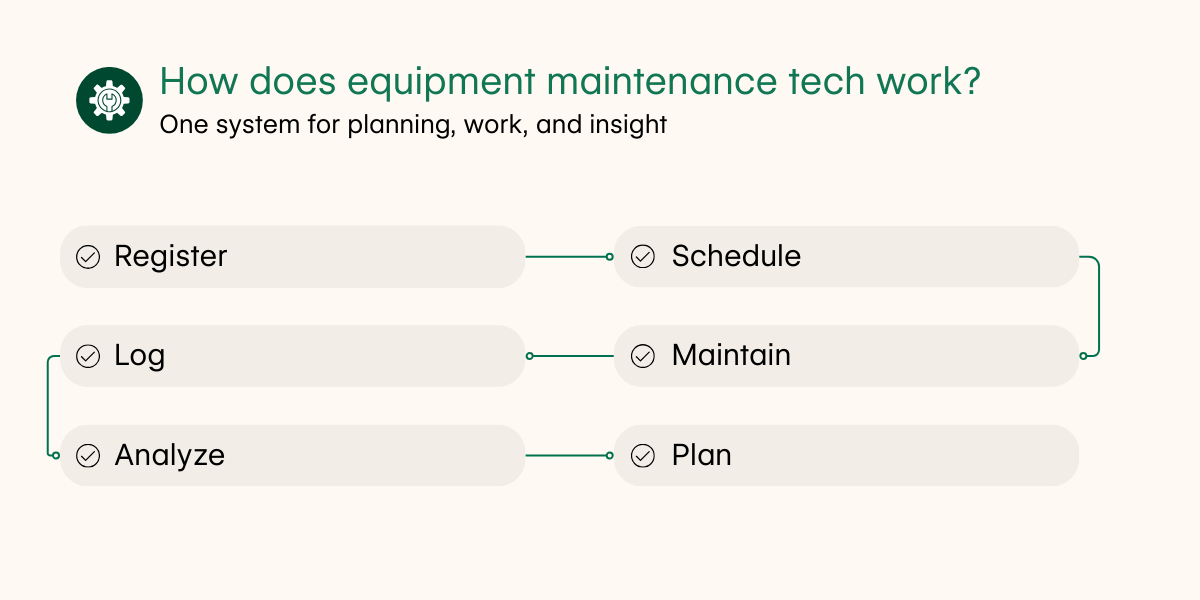
Equipment maintenance tech works by centralizing how assets are tracked and maintained, so planning, field work, and follow-up all happen inside the same operational system:
- Equipment is registered with specifications, location, and service requirements.
- Inspections and maintenance tasks are scheduled based on time, usage, or condition.
- Work orders are assigned, completed, and documented through field and office tools.
- Each activity updates the equipment maintenance log tied to the asset.
- Historical data is analyzed to identify recurring issues and predict failures.
Insights inform future maintenance timing, replacement planning, and budgeting, supporting tenant operations and amenities management.
Why does your CRE firm need equipment maintenance software?
Most asset-heavy industries already manage equipment through structured maintenance systems. Manufacturing uses predictive servicing to avoid production stoppages. Healthcare tracks equipment conditions to meet strict safety standards. Logistics depends on uptime to keep supply chains moving. Commercial real estate, by contrast, has often managed similar asset risk with spreadsheets, emails, and reactive workflows, even though buildings rely just as heavily on HVAC systems, elevators, pumps, and industrial equipment to function.
Across asset-heavy industries, structured maintenance programs are linked to reduced or stabilized unscheduled downtime, while fragmented maintenance processes continue to drive higher downtime costs over time. Unplanned equipment downtime costs the average Fortune 500 company $2.8 billion per year, or about 11% of annual revenue. In CRE, the impact shows up differently but just as clearly, through tenant disruption, emergency vendor spend, compliance exposure, and faster asset deterioration. And although the onboarding and implementation process across maintenance workflows remains slow, 65% of industry leaders expect to adopt AI maintenance solutions within the next 12 months, signaling that predictive, data-driven equipment maintenance is becoming standard.
Equipment maintenance software adoption challenges vs. benefits for CRE firms
How a CRE firm manages equipment maintenance increasingly separates teams that plan asset performance from those that react to asset failure.
How does maintenance software prevent equipment downtime?
If you've ever wondered how predictive maintenance software reduces equipment failures, and by extension equipment downtime, there are several clear ways equipment maintenance software is used across CRE portfolios, keeping assets running and service interruptions predictable rather than disruptive.
Preventing repeat failures through complete equipment maintenance logs
In large CRE portfolios, the same asset often goes through repeat repairs because maintenance history is fragmented across buildings and teams, instead of living in one shared record. Equipment maintenance tracking software ties every inspection, service, and repair to a single asset record, creating a continuous equipment maintenance log. For industrial equipment maintenance and heavy equipment maintenance in particular, this visibility exposes recurring faults, skipped steps, or short-term fixes that often lead to repeated downtime across buildings.
Scheduling equipment preventive maintenance based on real usage
Calendar-based servicing runs the risk of missing opportunities to keep equipment up and running when early signs of wear begin to surface. Equipment preventive maintenance uses runtime, cycles, or condition thresholds to trigger service before failure occurs. When it comes to facility management and office maintenance, this approach keeps HVAC systems, pumps, and floor maintenance equipment operational during peak use, rather than reacting after equipment shuts down.
Focusing maintenance effort where downtime risk is highest
Not all equipment affects tenant experience or building operations equally. Equipment maintenance tracking allows teams to see which assets support critical functions across commercial real estate property management activities. This supports smarter prioritization inside work order management and CMMS workflows, where teams address the highest downtime risk first.
Capturing field data accurately with a mobile equipment maintenance app
Downtime often escalates when field work is logged late or incompletely. An equipment maintenance app lets technicians document inspections, attach photos, and close tasks on-site. This keeps records accurate for commercial property inspections, supports building compliance software requirements, and reduces the chance that unresolved issues resurface as emergency failures.
Using predictive maintenance to spot failure patterns early
Predictive maintenance software analyzes historical equipment maintenance logs across similar assets such as HVAC units, elevators, and industrial machinery, making recurring issue patterns visible before failures occur. When the same performance drop or fault appears repeatedly, teams can adjust service timing across all related equipment, reducing emergency repairs and unplanned downtime. This condition-based approach supports smart buildings and PropTech that responds to real equipment behavior, while feeding commercial real estate data analytics with reliable performance data that improves long-term maintenance planning across CRE portfolios.
Preventing extended downtime caused by parts and vendor delays
Downtime often lasts longer because spare parts are missing or vendor responsibility is unclear. Equipment maintenance solutions connect maintenance activity with inventory records, vendor details, and contract management software. When a task is triggered, teams know which parts are available and which vendor is accountable, reducing delays.
What does equipment maintenance tracking look like with Visitt?
With Visitt, equipment maintenance software operates as part of a broader centralized portfolio operations platform. Industrial equipment, heavy equipment, and floor maintenance equipment are all handled inside the same operational system, so maintenance activity is no longer split across spreadsheets, emails, or separate tools. Every inspection, service, repair, and preventive maintenance task is logged automatically against the specific asset, creating a complete and auditable equipment maintenance history without manual tracking.
Preventive equipment maintenance is scheduled and managed at scale based on time, usage, or regulatory requirements, keeping service consistent and visible before failures occur. Maintenance status and upcoming service are available in real time across assets, teams, and locations. And field technicians update logs, complete checklists, attach photos, and close tasks directly from a mobile equipment maintenance app, ensuring maintenance data is captured accurately at the source. As this data accumulates, recurring issues and service patterns highlight equipment that requires earlier intervention, creating predictive maintenance flows that help property teams reduce unplanned downtime and extend asset lifespan.
See how Visitt supports smarter equipment maintenance across your portfolio