
Product Releases
Sep 30, 2026
How CRE Operators Prove ROI From Building Operations Software
Five steps to go from "it feels valuable" to a business case your buying committee approves.
Office building class determines cost, tenants, and operational load. Here is what that means for your CRE firm before you sign anything.

Every investment decision, leasing strategy, and operational commitment in office real estate starts with class. But how do you make the right call when the same asset qualifies as commercial real estate Class A office space in one market and Class B in another, and the classification criteria shift depending on who you ask?
The answer lies in knowing what each class demands, from the capital required to acquire and maintain it, to the tenants it attracts, to the service standard your team will be held to every day.
What does that mean for investors and property managers building or running a portfolio across multiple office building types?
While BOMA International and NAIOP offer the frameworks that make classification comparable across markets, they aren’t forged in stone, so we’ve provided a clear distinction between the building classes and what they mean for you.
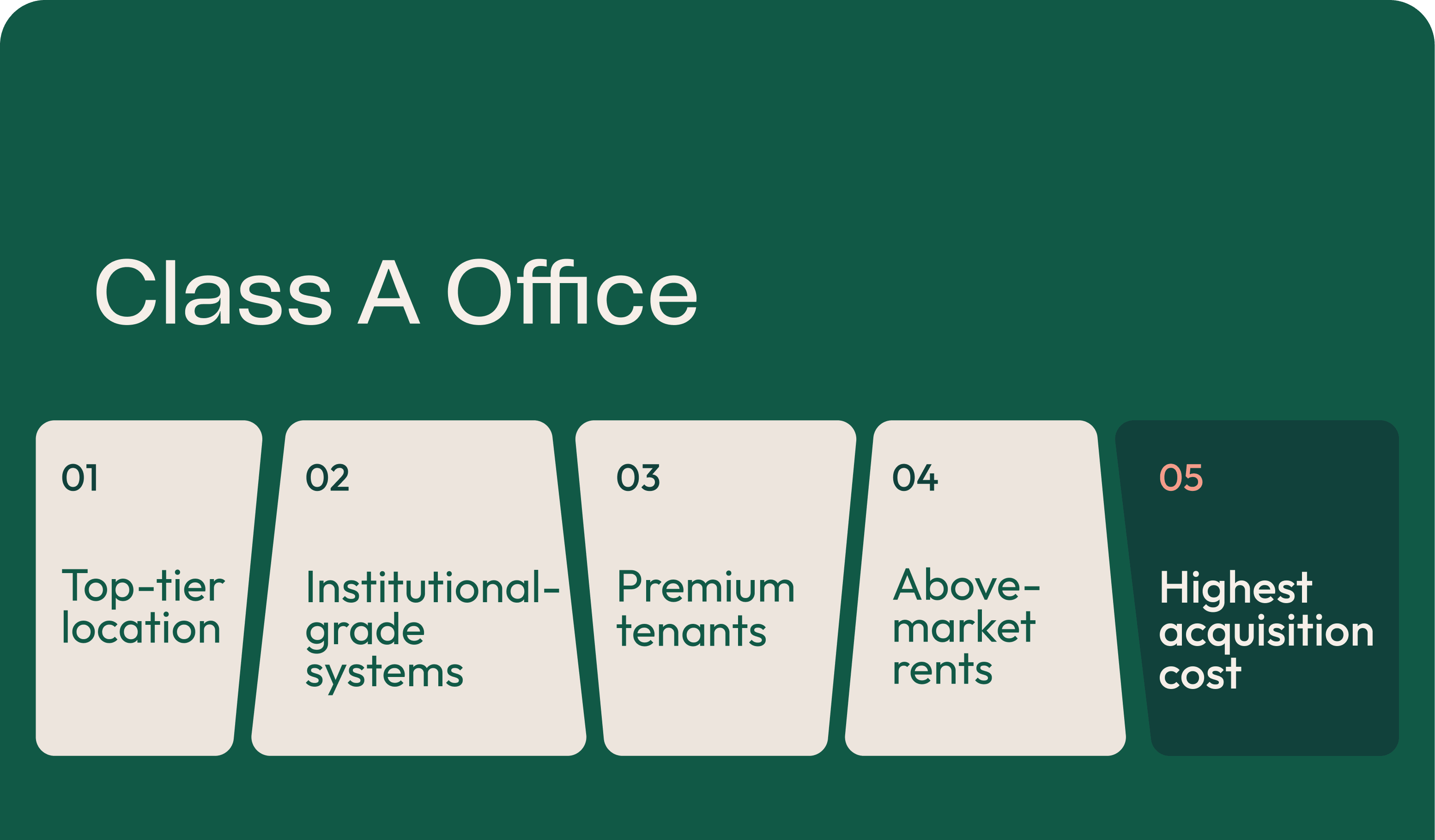
What is a Class A office building? Class A office space represents the top tier of the office market in any given area. Class A office buildings sit in prime central business districts or on well-appointed suburban campuses with strong accessibility and visibility. The quality of construction, caliber of ownership, and standing in its market are all determining factors.
Class A commercial real estate attracts institutional-grade tenants, law firms, financial services companies, and enterprise corporations, who sign long leases and have the financial stability to honor them. That tenant profile comes with elevated service expectations: the systems, service, and tenant experience must all perform at the same level as the rent being charged.
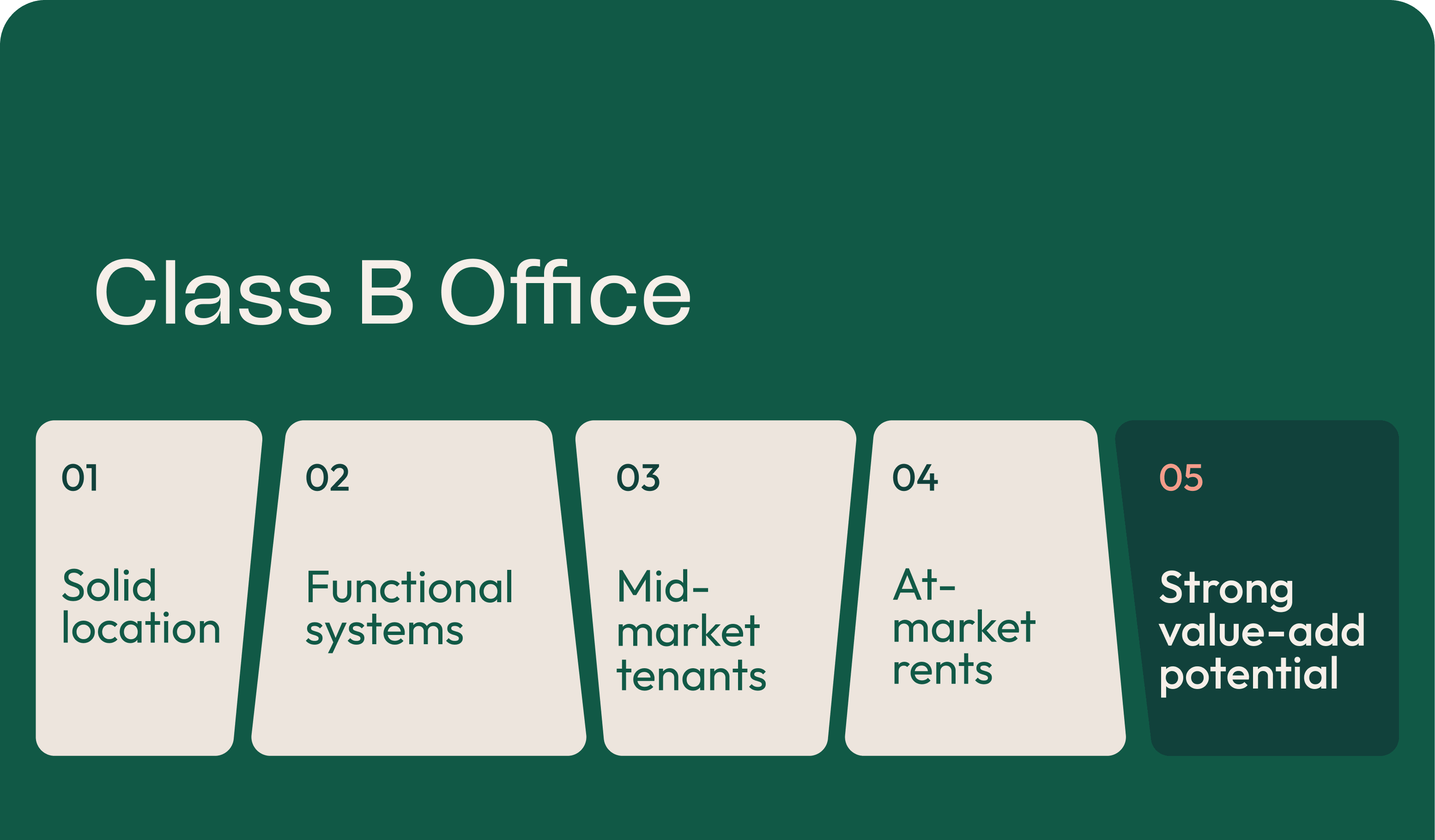
What is a Class B building? Class B office space competes for a wide range of tenants at average market rents. A Class B building is typically between 10 and 20 years old, well located in solid markets, and fully functional, without the high-end finishes and institutional systems of Class A. Finishes may be dated, but building operations and management quality are generally good.
Note: Well-located Class B buildings can be repositioned to Class A through targeted capital improvements, making them one of the most active segments of the office investment market.
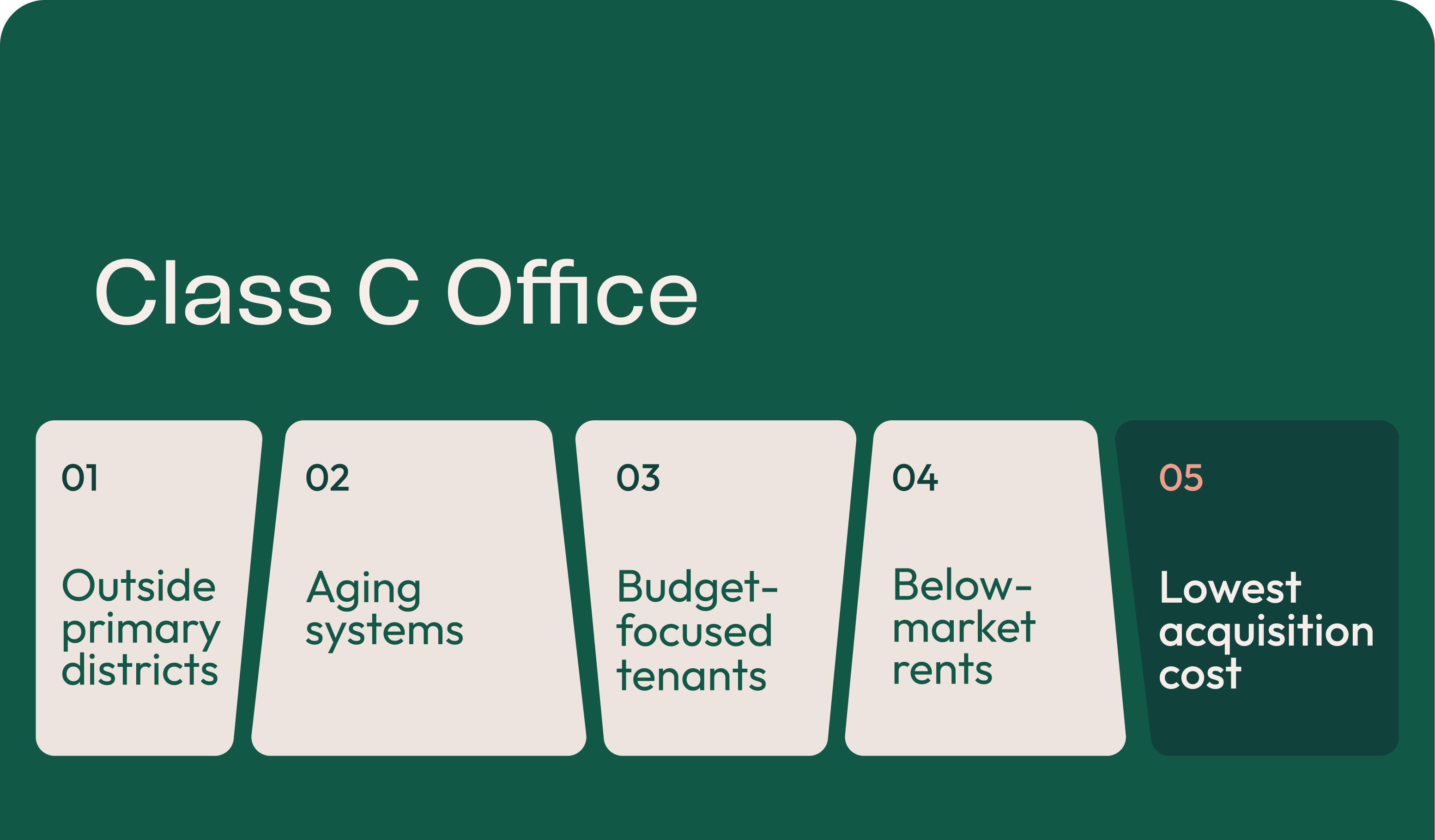
Class C office space represents the oldest and most affordable assets in any market, typically over 20 years old and located outside primary business districts. Infrastructure is often outdated, and systems may lack the capacity of newer builds. Thus, the opportunity in Class C is capital-driven: acquire at a low basis, invest in targeted renovations, and reposition toward Class B status. The risk is execution; renovation costs can escalate quickly, and commercial property maintenance on aging systems adds operational overhead before a single improvement is made.
Matching the right office building class to your investment and operational goals comes down to three factors: your capital position, your target tenant profile, and your appetite for operational complexity. The decision starts with investment horizon and risk tolerance, then narrows based on what the market supports and what the asset demands from the team running it. And across all three classes of office buildings, the operational demands compound as portfolios grow:
They all need to work together, whether you are managing a single A Class building or a mixed portfolio spanning all three tiers. Visitt centralizes every one of those workflows in one AI-powered building operations platform, giving property teams consistent visibility and control across every asset class, location, and building type in their portfolio.
If your team is ready to run buildings of any tier from one connected platform, talk to our team and explore how we can work together.
Office building classes are a framework used across commercial real estate to categorize office space by quality, location, infrastructure, and tenant profile. Class A represents the most prestigious buildings, Class B covers functional mid-market space, and Class C covers older buildings at below-market rents. Classifications vary by market and are not governed by a single official standard.
No single authority assigns office building classes. BOMA and NAIOP provide broad frameworks, but classifications are ultimately determined by local market consensus among brokers, landlords, and investors. A building considered Class A in a secondary market may only qualify as Class B in a major metro, which is why class always needs to be read in context.
Class directly impacts what tenants expect and what landlords can justify. Class A buildings command above-market rents and attract tenants who need to project prestige. Class B tenants negotiate harder on rate and often expect improvement allowances. Class C leases tend to be shorter and more flexible, reflecting the lower capital commitment on both sides.
Yes. Class B buildings are frequently repositioned to Class A through capital improvements to systems and amenities. Class C buildings can move to Class B with significant renovation investment. The upgrade path requires careful alignment between capital expenditure, target tenant profile, and local market conditions to generate the intended return.
Visitt centralizes work orders, preventive maintenance, commercial property inspections, and compliance across Class A, B, and C buildings across asset types – office, industrial, retail, multifamily, mixed-use, and others – on a single platform. Whether managing premium systems in a Class A tower or running a value-add program across Class B assets, property teams get the same real-time visibility and operational control across every building in their portfolio.


Insights, trends, and practical ideas for smarter commercial real estate operations.

Discover how Visitt transforms operations and tenant
experience, portfolio-wide.