Product Releases
Sep 30, 2026
How CRE Operators Prove ROI From Building Operations Software
Five steps to go from "it feels valuable" to a business case your buying committee approves.
Most property management goals create more work; the right ones create better outcomes.
Every property management goal a commercial real estate property management team sets influences how the rest of the year runs, from which vendor SLAs get enforced, to when and how issues across building operations are identified and dealt with.
Deloitte's 2026 Commercial Real Estate Outlook found that 83% of CRE executives expect revenue growth this year, even as 68% anticipate higher expenses with fewer plans to increase spending. Property operations teams are being asked to produce more from the same capacity. That makes prioritization decisions at the start of the year more consequential than ever.
The teams running the strongest portfolios set smart goals for property management, aimed at higher-leverage outcomes, and build the week's actual priorities around them.
Can you say yours does?
Before setting property management goals for 2026, define what a stronger portfolio looks like at year-end.
The property management goals and objectives below carry the clearest long-term return on portfolio performance.
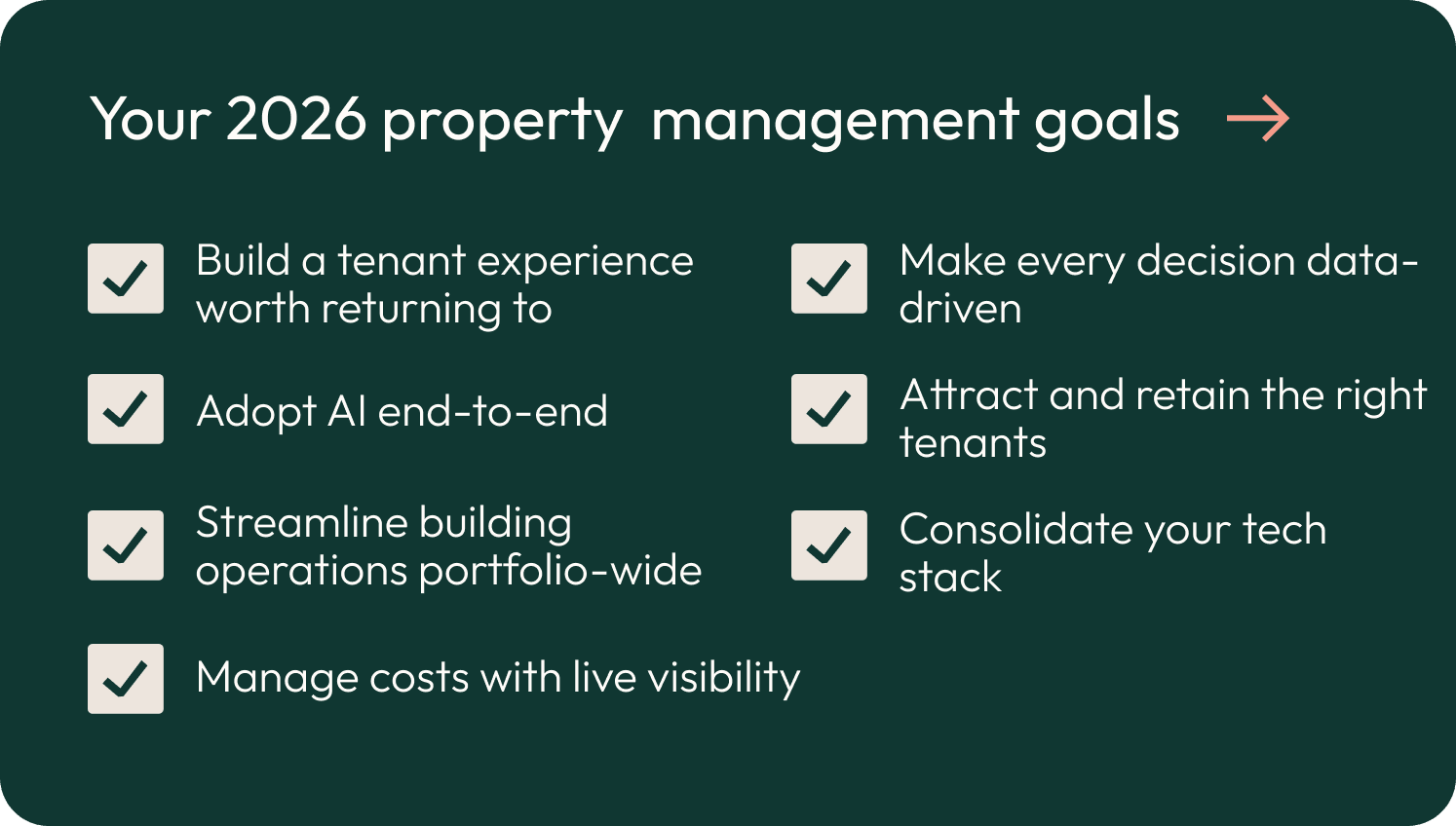
Property management teams running the strongest tenant programs treat tenant feedback as operational data that attracts new tenants and keeps existing ones re-upping at renewal.
Success looks like: Documented improvement in the lowest-rated tenant feedback categories, and renewal rates that reflect it at lease renegotiation.
How to achieve it?
AI property management software returns measurable value when it owns a defined workflow end-to-end.
Success looks like: The portfolio's highest-volume repeatable workflows running autonomously, with the team only handling exceptions.
How to achieve it?
The property operations teams delivering the most from the same headcount have built one consistent structure across all of it: defined, repeatable processes at every property, enforced at the portfolio level.
Success looks like: Every building operations workflow running to the same standard at every property, regardless of team size or composition.
How to achieve it:
The property management teams protecting NOI most consistently connect every expense category to a defined benchmark with a named owner and track both on a live basis.
Success looks like: Recoverable margin identified and closed within the quarter it occurs, with no expense category operating outside its benchmark for more than one consecutive period.
The property management teams making the most informed decisions use live building data to understand what each property needs, what it takes to address it, and the true cost of its deferral.
Success looks like: Every core property management KPI owned, dn operational decision.
How to achieve it:
Even the best individual tools create operational gaps when the data they hold stays siloed. A sustainable consolidation program brings those workflows together incrementally, preserving what each system does well while closing the gaps between them.
Success looks like: Core operational workflows running on one platform and feeding off each other’s information.
How to achieve it:
The property management goals for 2026 that carry the most return on portfolio performance run on a common operational foundation. Visitt's AI-powered property operations platform provides exactly that, connecting compliance and vendor management alongside work order routing and tenant operations in a single system, providing the live data structure to help your property manager goals be realized.
For CRE professionals whose career objective is property management leadership, Visitt is the platform the work runs on. Talk to our team and explore how we can work together.
AI adoption and tech stack consolidation have the most leverage this year. Both reduce manual workload and improve how decisions get made across the portfolio. In CRE, the property management goals that deliver the most measurable value are the ones tied directly to how the team spends its time.
Start by identifying where the same friction kept surfacing last year. From there, define what success looks like in measurable terms and assign a single owner. Building in a quarterly review keeps goals active and visible as daily operations across the portfolio pick up.
At its core, the objective of property management is protecting NOI while keeping operating costs predictable. That requires consistent process enforcement across every property in the portfolio so every asset performs to the same standard regardless of team size or composition.
Owning specific, repeatable workflows is where assistant property managers deliver the most consistent value. Tasks like work order follow-up and COI tracking directly support broader property management goals and objectives when a designated team member handles them within a defined SLA.
Visitt is an AI-powered platform built for commercial property operations. Portfolio teams get real-time visibility across every property, with vendor management and compliance running alongside work orders and tenant operations on one system. That operational clarity is what makes portfolio-wide property management goals achievable at scale.


Insights, trends, and practical ideas for smarter commercial real estate operations.

Discover how Visitt transforms operations and tenant
experience, portfolio-wide.