Product Releases
Aug 31, 2026
Visitt’s Work Order Request Process: Built for Property Teams Managing at Scale
Work order requests don't stop coming in; the property teams that handle them well have a process that scales with their portfolio.
Data silos quietly undermine visibility, slow decisions, and increase risk across property operations—making it harder for CRE teams to act with clarity, speed, and confidence.
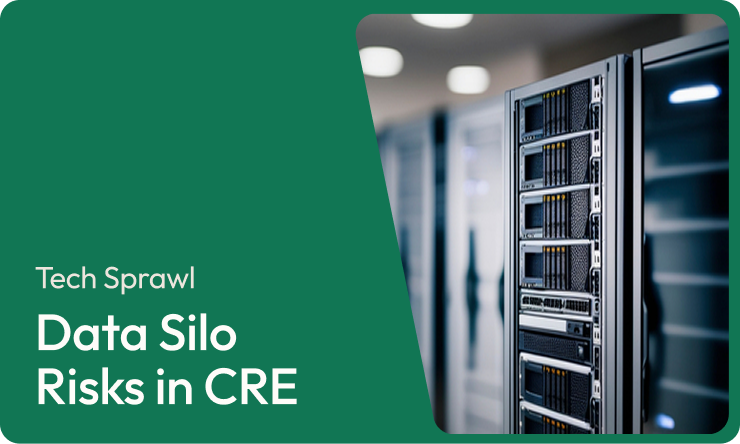
Successful property management depends on data, but most teams still don’t experience it as something they can consistently rely on. In 2025, 33% of finance teams reported struggling with inaccessible or siloed data, making accurate reporting harder to deliver. Forrester found that when employees need to pull information from multiple systems, 65% stop using data for decisions altogether. And research from the American Productivity and Quality Center showed that fragmented systems cost employees at least an hour every week searching for information. That time equals money, tenant satisfaction, and risk management initiatives CRE firms absolutely cannot afford to ignore.
If you’re going to make a resolution this time of year, might we suggest centralizing your CRE firm’s data to kick at least some of that risk to the curb?
CRE teams didn’t end up with fragmented systems by accident.
Over the past few years, operators added tools to keep up with the growing demands of commercial real estate property management in an increasingly digital world:
Each one solved a real, immediate need, but very few were added with integration in mind.

Overnight, building operations needed to be managed with fewer people on site. Access, maintenance requests, approvals, tenant communication, and reporting all had to move online, and fast. Property teams didn’t have the luxury of long planning cycles or clean system architectures. The priority was continuity. Whatever could be deployed fast enough to keep operations moving.
That rush filled gaps in the moment. It also set the stage for long-term tech sprawl.
Systems were layered on top of each other without a shared commercial real estate data analytics strategy. Each platform collected its own information, followed its own logic, and lived in its own workflow. Over time, teams adapted around the tools instead of the tools working together. And what started as a practical response turned into system fragmentation that now shapes how facility management operates every day.
Individually, those systems worked. The problem showed up in the space between them:
Each team experienced the impact and its risks differently, but the data silos were creating the same underlying challenges for them all:
Property teams are no longer operating in pandemic-style survival mode, where gaps could be excused because everything was urgent and improvised. And despite technology fragmentation pushing data to be collected in isolation, expectations moved in the opposite direction. Tenants now expect everything, everywhere, all at once:
At the same time, labor costs are up 20%, and teams are leaner than ever, meaning fewer people are responsible for making faster decisions based on more data across systems that were never designed to work together. That work doesn’t scale. It slows teams down, drives up cost, and turns everyday coordination into risk, in the form of tenant frustration and staff stretched too thin to stay ahead of issues.
Rising interest rates and economic uncertainty demand real-time decision-making, not outdated reports pulled from disparate systems. When markets shift or rates change, owners and investors need to know which properties are worth holding, where to invest more, and where losses should be cut before they deepen.
And that’s on top of ongoing ESG and compliance requirements that depend on unified, reliable data. When systems are fragmented:
Sick of an office maintenance request being closed in one system, while tenant complaints live somewhere else, with no shared visibility until the lease is already at risk?
Tired of asset managers making capex decisions based on data pulled manually from multiple platforms, knowing it’s already outdated by the time it’s reviewed?
Frustrated that leasing teams still can’t see which amenities or services actually drive retention, because usage data is trapped in access control or tenant systems that never connect back to leasing outcomes?
Data silos = operational silos.
These pains are symptoms of the same underlying issue: data living in isolation across fragmented systems. And treating them one by one will only take you so far.
What if, instead of applying more bandages, you could address the root cause with a single, centralized solution?

Visitt is built around one principle: risk drops when data is centralized and stays current. Bringing asset and equipment operations, tenant operations, tenant experience, and billing into a single source of truth, Visitt gives CRE teams a consistent, real-time view of what’s happening across the portfolio.
With unified data in place, AI can finally be applied where it adds real value, predicting maintenance needs, identifying retention risk, optimizing space utilization, and benchmarking performance across buildings. At One Congress in Boston, Carr Properties used Visitt to bring visitor access, tenant interaction, and building operations into one connected system, cutting check-in times by 84% and reclaiming more than 29 front-desk hours each month. And Epic Investment Services centralized operations across 170+ buildings, using Visitt’s real-time visibility and consistent workflows to improve response times, standardize service delivery, and increase tenant engagement.
Every day with disconnected systems is money left on the table and tenants at risk. Time to consolidate your data with Visitt.
Talk to our team and explore how we can work together
Because fragmented systems delay visibility, hide early warning signs, and force teams to make decisions with partial information, they increase exposure across operations, finance, compliance, and tenant experience.
Visitt creates a single source of truth by connecting asset operations, tenant activity, experience signals, and financial workflows in one platform, with integrations that keep data current across teams.
Visitt updates data continuously across buildings, so managers and asset teams can monitor performance, spot issues, and act based on current conditions instead of delayed reports.
Visitt uses AI on connected operational data to predict maintenance needs, identify recurring issues, streamline and translate communications, optimize resource usage, and provide performance insights across properties.
Yes. Visitt is built to support everything from individual assets to multi-city portfolios, with consistent workflows and visibility across hundreds of buildings.


Insights, trends, and practical ideas for smarter commercial real estate operations.