Product Releases
Sep 30, 2026
How CRE Operators Prove ROI From Building Operations Software
Five steps to go from "it feels valuable" to a business case your buying committee approves.
Better visibility. Faster response. Informed communications. That’s what separates proactive building operations from reactive ones.
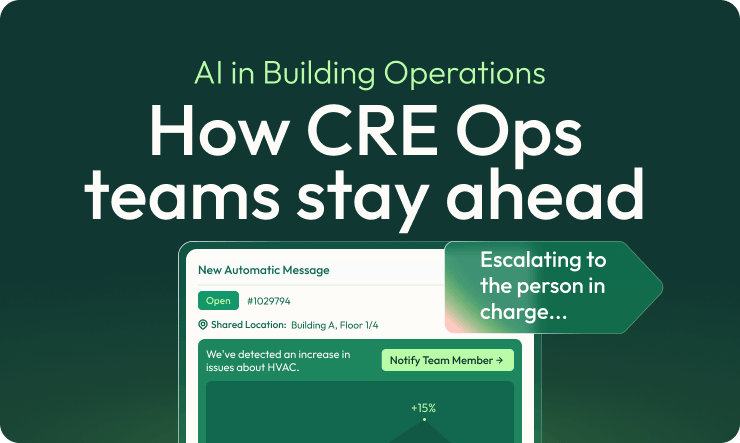
CRE property management has always been an operational discipline: track the work orders, keep tenants satisfied, manage the vendors, close the compliance gaps. What's changed is the volume of data, decisions, and moving parts that come with a growing portfolio.
AI is how leading property teams are handling it.
JLL's 2025 Global Real Estate Technology Survey found that 88% of real estate investors are piloting AI, with strategic priority shifting from operational wins to growth and competitive positioning. Teams that built their data infrastructure early are moving faster, yet over 60% of investors remain strategically, organizationally, and technically unprepared for scaled AI implementation. This, even as 87% report their real estate technology budgets have grown because of AI.
What does that mean for property managers like you?
Below is what Visitt is seeing across assets and portfolios, and how to get the most out of AI in your building operations today.
As AI algorithms grow more capable, the range of tasks they can handle across building maintenance and operations grow too. AI in building operations is reading COIs, routing work orders, predicting equipment maintenance needs, and optimizing energy efficiency in commercial buildings in ways that weren't possible five years ago.
The opportunity is real. A structured program is how it’s seized:
Integrating an AI building management system into your day-to-day operations the right way means less reactive work, faster maintenance response, and lower commercial property operating expenses across your entire portfolio.
Here are some practical tips.

The more consistently your team logs data in one place, the more your AI in buildings platform has to work with across your entire property operations portfolio.
Case study: After Epic Investment Services adopted Visitt's AI-powered property management operations platform, enabling live data capture across 170+ buildings, managers had a reliable way to monitor performance and enact consistent service and maintenance standards across the portfolio. Tenant requests tracked increased 291%, and median response time dropped to 10 minutes. See how we did it →

Tenant communication
Artificial intelligence in facility management moves maintenance scheduling from fixed calendar dates to live asset usage data. To make the most of it:
Case study: After Carr Properties adopted Visitt's AI-powered building operations management system, enabling automated preventive maintenance tracking across their portfolio, the team could identify equipment patterns and flag recurring faults before they reached failure. Today, 25% of work orders are proactively created by the team, with 58% of service requests resolved within the first hour and 82% within three hours. See how we did it →

When your building management software uses AI to surface the right information at the right time, your team always knows what to communicate, to whom, and when.
Case study: After Related Ross adopted Visitt's building maintenance and operations solution, enabling automated handling of every transactional tenant touchpoint across their West Palm Beach portfolio, tenant engagement increased 3X and satisfaction reached 4.9 out of 5 within two months. See how we did it →

When your building operating system connects to the platforms your team already uses, every stakeholder has the visibility to truly own their portfolio's results.
Case study: After One Congress adopted Visitt, they connected SwiftConnect to automate visitor credential activation and access end-to-end. The front desk team was freed from manual check-in entirely: check-in dropped to 20 seconds, 29+ hours of front desk time were reclaimed monthly, and 80% of entries became tenant-initiated. See how we did it →
The best-run portfolios in commercial real estate share one thing: a single AI-native platform connecting every operational layer underneath them.
Visitt’s AI is built for exactly that: work order intelligence that connects recurring issues and escalates urgent work, a COI Agent that runs compliance end to end, Live Translate for multilingual teams, and AI agents that handle the repetitive operational layer so your team focuses on what requires their expertise.
If your team is ready to reduce reactive work, lower operating costs, and give leadership the visibility they need to make better decisions, talk to our team and explore how we can work together.
AI in building operations is a system that captures live operational data, identifies patterns across work orders, maintenance activity, and tenant behavior, and infers what should happen next, so your team spends less time deciding what to do and more time doing it.
The most common starting points are work order management and maintenance tracking, because that's where the data already exists. From there, teams layer in tenant communication automation and system integrations. Each one compounds the last, so the portfolio gets easier to run as you add more.
You'll see value from day one. Requests that used to fall through the cracks get tracked, and the longer you run it, the more it compounds: higher tenant satisfaction, fewer surprises, and a clearer picture of what's actually happening across your portfolio.
No, and that's not what it's designed to do. Your team still owns the relationships, and all the strategic, investment-oriented execution. What changes is how much of their day gets spent on structured, repetitive work. For most teams, that's a significant amount of time back.
Visitt has been building AI into property operations since 2022, before most competitors had it on their roadmap. The platform was designed from the ground up for AI to run workflows end to end, while others are adding AI features onto systems built 15 years ago.


Insights, trends, and practical ideas for smarter commercial real estate operations.

Discover how Visitt transforms operations and tenant
experience, portfolio-wide.