What is Vendor Invoice Management and How do CRE Teams Use it to Handle Vendor Billing?
Key takeaways:
Vendor invoice management is the process businesses use to receive, review, approve, and record vendor invoices so billing reflects actual services, follows approval rules, and supports accurate accounting and audits.
Across CRE portfolios, vendor invoice management helps teams stay aligned as invoice volume grows, services repeat, and work spans multiple properties, reducing friction between operations, finance, and vendors.
Visitt supports vendor invoice management by tying vendor billing to work orders and maintenance activity and integrating with property management systems, so invoice review stays connected to real operational data across properties.
What is vendor invoice management?
Vendor invoice management (VIM) is the process a business uses to handle invoices from vendors and service providers, from receipt through approval, payment, and recordkeeping. It applies across industries, supporting organizations that rely on third-party vendors to deliver goods or services on an ongoing or one-time basis.
Core features of vendor invoice management software features include:
- Invoice capture and processing from emails, PDFs, and digital uploads
- Configurable approval workflows based on invoice value or vendor type
- Invoice matching against amenity purchase orders, service records, or receipts
- Integrations for vendor and invoice management with accounting or ERP systems
- Support for recurring billing tied to ongoing services
- Status visibility and reporting for outstanding and approved invoices
For CRE firms, vendor invoice management systems operates alongside building operations and typically involves:
- Reviewing invoices against work orders and predictive maintenance activity
- Managing recurring vendor billing across multiple properties
- Coordinating approvals between property, operations, and finance teams
- Aligning operational costs with accounting and reporting systems
- Maintaining traceable records tied to buildings, vendors, and services
These workflows intersect with work order management and CMMS platforms, facility management tools, and contract management software.
What information is on a vendor invoice?
Vendor invoices are required to include the same core categories of information so they can be processed consistently for accounting and auditing purposes.
| Invoice Field | Purpose |
|---|---|
| Invoice date | Starts payment terms and defines due dates |
| Unique invoice number | Creates an audit trail and prevents duplication |
| Vendor and buyer details | Identifies parties involved |
| Itemized goods or services | Defines what was delivered and billed |
| Quantities and unit prices | Enables charge validation |
| Payment terms | Clarifies timing and conditions |
| Taxes, fees, and totals | Confirms the full amount due |
| Purchase order or reference IDs | Links invoices to upstream records |
How does vendor invoice management improve vendor relationships?
Tools for automating vendor invoice management improve vendor relationships by replacing manual handoffs with a structured process that moves invoices through defined stages.
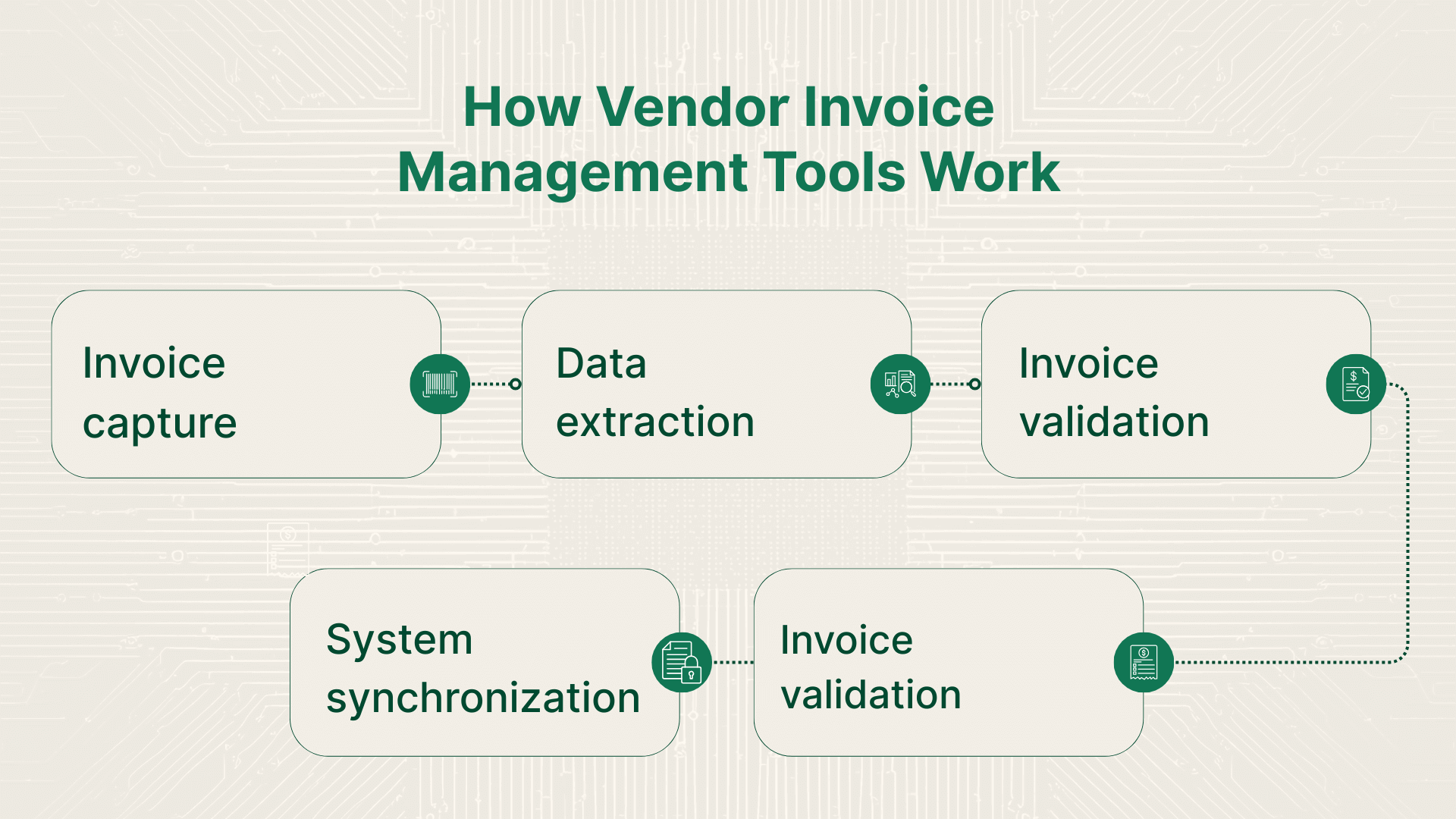
- Invoices are received through email, portals, or uploads and entered into the system as the starting point of the invoice workflow.
- Key invoice details such as vendor name, invoice number, dates, and amounts are extracted and stored in standardized fields for processing.
- Invoice data is checked against available purchase orders, service records, or operational references to confirm accuracy and completeness.
- Invoices are automatically routed to the appropriate reviewers based on factors such as value, vendor, or service category.
- Approved invoice data is passed to accounting or property management systems to support payment and financial reporting.
- Once paid, invoice records are stored securely to support future audits, reporting, and vendor reference.
Why is vendor invoice management important for CRE firms?
At scale, limited visibility into invoice status makes it difficult to understand committed spend, forecast cash flow, or identify billing issues before payment is issued, leading to duplicate invoices, charges that exceed contracted rates, delayed approvals, and late payment penalties. This challenge is common across industries: a survey found 92% of financial decision makers admit they pay suppliers late, showing how easily backlogs and weak controls become the default.
The best tools for vendor invoice management reduce these risks. At a minimum, they ensure invoices:
- Reflect agreed-upon services
- Follow internal approval rules
- Comply with payment terms
- Are accurately recorded for financial control and audit purposes
AI-driven vendor invoice management software extends this by extracting invoice data, applying rule-based validation, and flagging exceptions such as pricing variances or missing references for review. Automated matching and workflow routing shorten approval cycles and reduce error rates, while real-time visibility into invoice aging and spend supports faster financial close and more accurate forecasting. This also protects vendor relationships, where payment reliability directly affects service continuity.
What are best practices for tracking vendor invoices in property management?
Vendor invoice management initiatives improve when software supports the full invoice lifecycle, from intake to approval to system sync. Vendor invoice management software helps teams capture invoices consistently, link them to operational data, apply controls automatically, and keep records aligned across systems across use cases.
Linking vendor invoices to work orders and maintenance activity
Project managers responsible for approving vendor invoices need a clear way to verify that the invoiced scope matches the work that was actually performed before payment is issued. In CRE environments, where vendors may bill for recurring services, partial work, or bundled jobs across multiple locations, this verification depends on access to accurate operational records. Vendor invoice management software associates invoices with work orders, service requests, or maintenance rounds, allowing reviewers to confirm that everything adds up before the invoice moves forward.
Best practices when using vendor invoice management software:
- Configure the system to require a work order, service request, or preventive maintenance reference on each invoice
- Use stored task details, dates, and smart building locations to validate invoice line items
- Review invoices alongside completion notes and service history recorded in the system
Centralizing vendor invoices across properties and vendors
Property managers and accounting teams overseeing multiple buildings need to know the status of each vendor invoice in the review and approval process. Invoices arrive from different vendors, cover different properties, and move through different reviewers. Vendor invoice management software centralizes invoice intake and storage, so teams can see invoice status, supporting documents, and history across properties.
Best practices when using vendor invoice management software:
- Capture vendor invoices from multiple submission channels into one system
- Store invoices together with related vendor and property records
- Use standardized fields to track invoice status across the portfolio
Standardizing invoice review and approval workflows
Teams responsible for approving vendor invoices need consistency in how invoices are reviewed, routed, and approved. In property management, approval requirements often vary based on invoice value, service type, or vendor, which can lead to delays if workflows are informal. Vendor invoice management software applies predefined approval rules and routing logic, ensuring invoices predictably move through the correct reviewers.
Best practices when using vendor invoice management software:
- Define approval workflows based on invoice value or service category
- Use automated routing to assign invoices to the correct approvers
- Monitor approval progress to identify bottlenecks before payments are delayed
Connecting vendor invoice management with financial systems
Once invoices are approved, finance teams need invoice data to flow accurately into commercial real estate property management and accounting systems for payment and reporting. Across the CRE industry, invoice details often need to be recorded both in operational systems and in accounting or property management platforms, which increases the risk of mismatches between operational records and financial data. Integrations for vendor and invoice management keep invoice, vendor, and cost data aligned across systems.
Best practices when using vendor invoice management software:
- Integrate invoice workflows with AI property management software or accounting platforms
- Keep vendor records consistent across operational and financial systems
- Use system references to reconcile approved invoices with payment records
Using invoice history to support vendor oversight
Over time, vendor invoice data shows how consistently a vendor bills for similar work across properties, including recurring corrections, exceptions, and pricing variation. Vendor invoice management software stores invoice history in a searchable system record, so teams can review patterns and make decisions based on documented billing behavior.
Best practices when using vendor invoice management software:
- Track invoice corrections, exceptions, and approval timelines by vendor
- Compare billed amounts across similar services or properties
- Use historical invoice data to support vendor reviews and renewal decisions
What does vendor invoice management look like with Visitt?
Vendor invoice management is an intuitive part of Visitt's PropTech solution. Vendors are associated with work orders and commercial property maintenance at the planning stage, so billing reflects work that is defined and documented. This creates continuity between operational activity and financial follow-up, reducing the need to reconcile invoices against separate records or informal tracking.
As work progresses, costs can be recorded and reviewed within Visitt, allowing teams to track vendor spend in the same environment where maintenance activities are managed. For portfolios that rely on property management systems for billing, Visitt supports end-to-end workflows through integrations with platforms such as Yardi and MRI Software. Operational data and financial records remain connected, giving teams clearer oversight of vendor billing across properties.