Blog posts

8 CRE Property Management Certifications That Build Portfolio-Wide Trust

Property managers, this one’s for you! These certifications tell CRE firms they’ve found a property manager who invests in the portfolio as much as they do.

By
Team Visitt
Released
May 15, 2026
Last update
May 21, 2026
Property Operations

TL;DR

  • Commercial property managers sit at the center of every ownership, investment, and tenant relationship in a portfolio, and the trust those relationships are built on reflects directly how deeply they have invested in mastering the work
  • These eight property management certifications and designations are the ones leading commercial property professionals prioritize to build lasting trust with the owners and investors running their portfolios
  • Visitt gives certified property managers the building operations tech to ensure their portfolio always reflects the standard their credentials represent, so owners and investors stay confident in the team managing their assets

Commercial real estate property management is a relationship business, touching every layer of a portfolio: 

Owners call property managers when an unplanned equipment failure threatens the tenant experience. Tenants hold you accountable when response times slip or satisfaction scores follow, and investors trust you to ensure SLAs are consistently met across every asset in every building.

JLL's research on enterprise resilience finds that commercial real estate professionals are building risk management strategies that protect their portfolios against disruption. Practically, this means owners and investors now expect commercial property managers to meet the latest property management standards, and hold up under scrutiny and across market cycles at scale.

Property management certifications and property management designations put that commitment on paper, demonstrating that the commercial property manager holding it is dedicated to being the best they can, for the people their work serves. 

Based on what the Visitt team has seen across the property teams we work with, these are the ones worth earning. 

Certifications and property management designations make your commitment clear

The commercial property managers who build the longest, most trusted relationships across portfolios make a visible, sustained commitment to consistently performing better: 

  • Acquiring new skills
  • Deepening their knowledge of the financial and operational dimensions of the assets they manage
  • Applying what they learn every single day across every property in their portfolio. 

A commercial property certification tells everyone evaluating your work, from tenants to owners to institutional investors,  that you’ve invested in building expertise in a specific operational area, whether that is sustainable property management, facility management, or industrial property management

A property management designation tells them you’ve proven they can handle the full scope that institutional-grade commercial real estate property management requires, over time and across disciplines.

Certification Designation
What it validates Specialized knowledge in a defined operational area Mastery across multiple operational disciplines
How competency is assessed Coursework and certified property manager exam Coursework, verified experience, and management plan
Experience requirement Varies; some require none Verifiable track record managing commercial assets
Continuing education Varies Required to maintain the credential
What owners and investors see A commercial property professional investing in a specific area of expertise A manager who has proven their standard across the portfolio
Examples CMCP, LEED Accredited Professional, Certified Facility Manager CPM designation, RPA designation, Accredited Commercial Manager

How property management certifications and designations differ in what they require and what they communicate to owners and investors evaluating portfolio leadership.

A note for commercial property managers researching how to become a certified property manager, or how to get CPM certification: The Certified Property Manager credential uses "certified" in its title but is classified as a designation because its requirements exceed standard certification criteria. (See below)

The 8 property management certifications and designations CRE professionals earn to build lasting trust 

Before you decide where to invest in professional development, these are the eight credentials that CRE property administrators, facilities management administrators, and senior commercial property managers consistently point to as the ones worth earning:
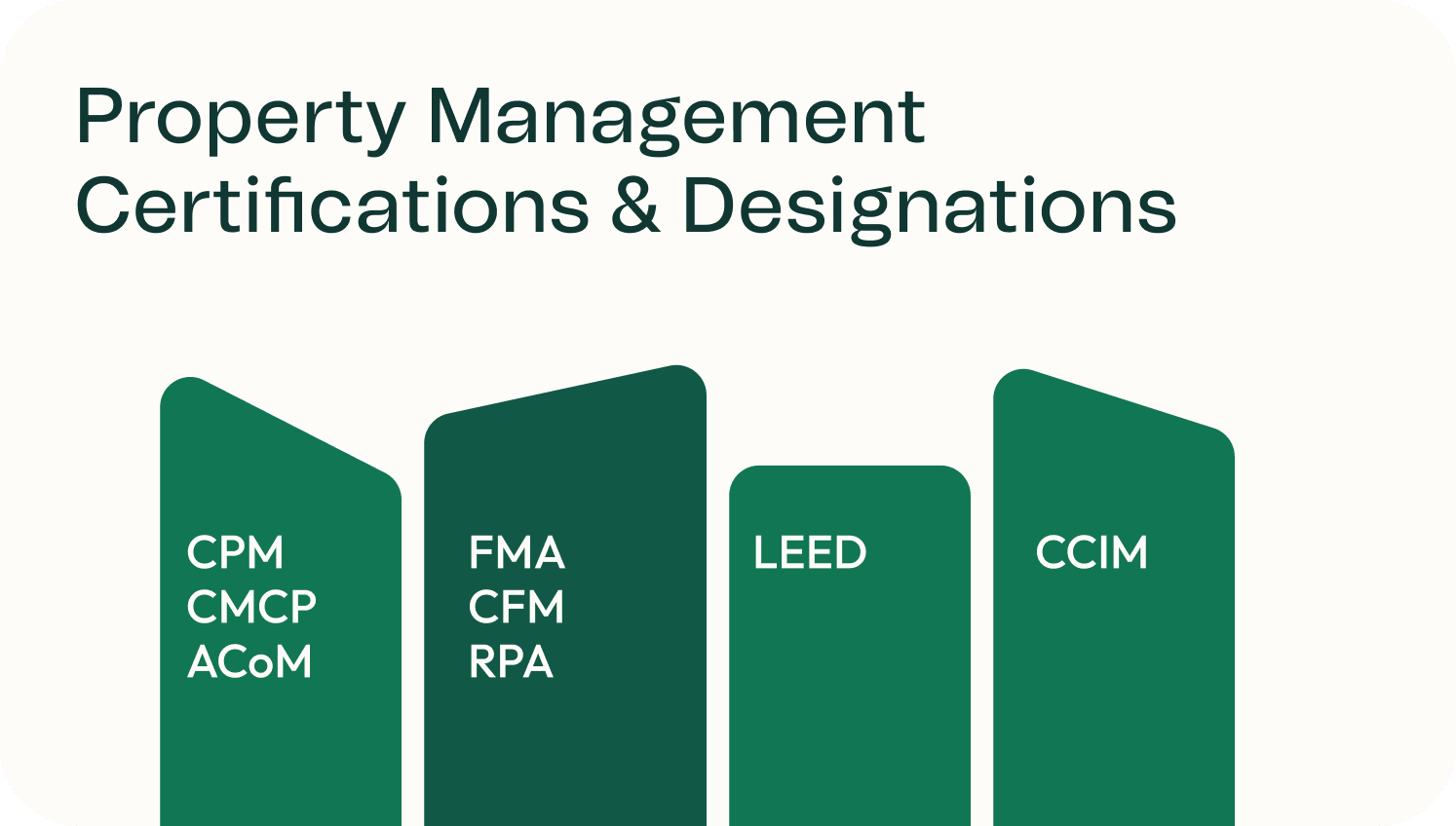
  1. Certified Property Manager (CPM)
  2. Certified Manager of Commercial Properties (CMCP)
  3. Real Property Administrator (RPA)
  4. Facilities Management Administrator (FMA)
  5. Certified Facility Manager (CFM)
  6. LEED Accredited Professional (Operations + Maintenance)
  7. Accredited Commercial Manager (ACoM)
  8. Certified Commercial Investment Member (CCIM)
Property Management Certifications & Designations

Certified Property Manager (CPM)

Type Designation
Provider Institute of Real Estate Management (IREM)
Best for Senior property managers, portfolio managers, and asset managers responsible for full commercial asset performance
Requirements
  • Three or more years of qualifying commercial property management experience
  • Completion of advanced coursework covering finance, leasing, operations, and ethics
  • Submission of a management plan demonstrating applied competency, and
  • Passing a comprehensive capstone assessment; a Certified Property Manager exam that covers every dimension of portfolio leadership
Continuing education Required to maintain the designation

Core details of the Certified Property Manager CPM designation, including type, provider, ideal candidate profile, and requirements.

The Certified Property Manager designation is the one owners, investors, and institutional management firms point to when evaluating whether the person running their assets has proven their competency across the full scope of the role. Holding the CPM tells the people depending on you that the decisions being made across their portfolio are in the hands of someone tested against the highest standard in the industry:

  • Analytical depth across financial performance and net operating income that owners and investors expect at the leadership level
  • A risk management framework that holds up under lender and investor scrutiny across market cycles
  • The leasing and operational knowledge to protect asset value as portfolios grow and market conditions shift
  • Recognition by institutional management firms as the advanced standard for commercial real estate leadership

Certified Manager of Commercial Properties (CMCP)

Type Certification
Provider BOMA/BOMI International
Best for Commercial property managers with 1 to 5 years of experience looking to validate foundational knowledge
Requirements
  • Approximately 30 hours of preparatory coursework covering commercial property operations and leasing
  • A certification exam covering tenant relations, building maintenance, risk management, and financial reporting
Continuing education Not required to maintain the certification

Core details of the Certified Manager of Commercial Properties CMCP certification, including type, provider, ideal candidate profile, and requirements.

The CMCP is where serious commercial property managers begin building the professional foundation that owners and investors recognize over time. It validates core competency across leasing support, preventive maintenance coordination, risk awareness, and financial reporting, giving early-career managers the documented standard that accelerates how quickly they earn trust in the role:

  • Fluency in the financial reporting and property management KPIs that owners use to measure management quality from day one
  • A credible signal to employers and asset owners that foundational knowledge has been tested against an industry standard
  • A structured on-ramp to more advanced commercial property certifications, with built-in credit toward the RPA program, exempting holders from re-testing on fundamentals already proven. 
  • The professional standing to take on greater portfolio responsibility earlier in a CRE career

Real Property Administrator (RPA)

Type Designation
Provider BOMI/BOMA International
Best for Commercial property managers and asset managers focused on the operational and financial performance of office, industrial, and mixed-use buildings
Requirements
  • Completion of eight structured courses covering law, finance, building systems, and asset management
  • Three years of documented commercial property management experience
  • Adherence to professional and ethical standards
Continuing education Required to maintain the designation

Core details of the Real Property Administrator RPA designation, including type, provider, ideal candidate profile, and requirements.

The Real Property Administrator designation focuses on how commercial buildings operate as financial and physical assets, and what that means for the managers responsible for their performance. Managers holding the RPA designation demonstrate deep understanding of the financial consequences of every operational decision they make, and can reliably and consistently apply that understanding to support the portfolio's strategic goals at scale:

  • The financial and asset management fluency to have ownership-level conversations about capital planning and building performance
  • A working knowledge of building systems, environmental health and safety, and commercial lease management that makes a commercial property manager the most informed person in the room
  • The risk management and compliance framework that lenders and investors expect from the professionals overseeing their assets
  • A designation that tells owners and institutional management firms that their buildings are being run with the same rigor they would apply themselves

Facilities Management Administrator (FMA)

Type Designation
Provider BOMI/BOMA International
Best for Facility managers and property managers responsible for daily building operations, from maintenance execution to tenant experience
Requirements
  • Completion of facilities-focused coursework covering building systems, energy management, and safety
  • Three years of demonstrated experience in building operations or facility management
  • Application of safety, maintenance, and operational planning principles
Continuing education Required to maintain the designation

Core details of the Facilities Management Administrator FMA designation, including type, provider, ideal candidate profile, and requirements.

The Facilities Management Administrator designation is the credential that tells owners and investors that you understand how daily operational decisions, from maintenance scheduling to energy controls, directly affect what tenants experience and capital expenses. Where other credentials validate financial and leasing competency, the FMA validates the layer underneath: the building-level execution that determines whether a portfolio performs to the standard it is being marketed and managed at:

  • A structured framework for asset maintenance that reduces unexpected breakdowns and keeps building systems performing reliably
  • The knowledge to evaluate service contracts and vendor performance against clear operational standards
  • Fluency in energy efficiency in commercial buildings and safety planning that directly affects operating costs and occupant experience
  • The operational standing to align facility performance with the strategic goals owners and investors have set

Certified Facility Manager (CFM)

Type Certification
Provider International Facility Management Association (IFMA)
Best for Experienced facility managers overseeing complex building systems, projects, and cross-functional operations
Requirements
  • Significant hands-on facility management experience
  • Passing a comprehensive scenario-based examination across IFMA's 11 core competency areas
Continuing education Required to maintain the certification

Core details of the Certified Facility Manager CFM certification, including type, provider, ideal candidate profile, and requirements.

IFMA describes the CFM as the industry standard for ensuring the knowledge and competence of practicing facility managers. The certified facility manager credential does something no other certification on this list does: it requires a commercial property manager to prove their competency in practice, not just demonstrate it through coursework. Because of this, a CFM on a manager's credentials is one of the clearest measures of operational leadership they will find:

  • Certification that institutional owners and investors recognize as proof that facilities are being managed as systems supporting long-term business continuity
  • Demonstrated mastery across asset lifecycle management, finance, technology, and sustainability as integrated disciplines
  • The leadership and project management depth to oversee complex initiatives across capital projects and cross-functional teams
  • The ongoing continuing education commitment that keeps a certified facility manager current as building technology and regulations update

LEED Accredited Professional (Operations + Maintenance)

Type Credential
Provider Green Business Certification Inc. (GBCI)
Best for Facility managers, building engineers, and property leaders responsible for sustainable building operations, ESG reporting, and environmental performance oversight
Requirements
  • Current LEED Green Associate credential
  • Passing the LEED AP Operations + Maintenance specialty exam
  • Demonstrated proficiency in the LEED v4.1 or v5 rating system
Continuing education Required to maintain the credential: 30 continuing education hours every two years with at least 6 specific to the O+M specialty

Core details of the LEED Accredited Professional Operations and Maintenance credential, including type, provider, ideal candidate profile, and requirements.

ESG reporting and sustainable property management have moved from differentiators to baseline expectations across institutional commercial real estate, and the LEED Accredited Professional credential is how yous demonstrate the expertise to deliver on both. A LEED AP on a manager's credentials tells commercial owners and investors that sustainability is being managed as a strategic discipline; LEED buildings consume approximately 25% less energy than non-certified buildings thanks to:

  • Advanced knowledge of energy efficiency, water conservation, and indoor environmental quality as operational performance levers
  • The expertise to lead building performance tracking and decarbonization strategies that align with owner and investor ESG commitments
  • Proficiency in the LEED rating system and documentation processes that streamline building certification and reduce reliance on external consultants
  • The standing to attract and retain quality tenants whose corporate sustainability goals make green building performance a lease decision factor

Accredited Commercial Manager (ACoM)

Type Designation
Provider Institute of Real Estate Management (IREM)
Best for Commercial property managers and assistant asset managers responsible for daily income-producing commercial building operations, progressing toward the CPM designation
Requirements
  • Minimum 12 months of documented CRE property management experience
  • Completion of IREM coursework
  • Submission of a commercial property management plan
  • Passing a comprehensive exam
Continuing education Required to maintain the designation

Core details of the Accredited Commercial Manager ACoM designation, including type, provider, ideal candidate profile, and requirements.

The Accredited Commercial Manager designation is the credential that positions commercial property managers for the step up from executing daily operations to owning the financial and operational outcomes of income-producing assets. For commercial property managers at the mid-career stage, the ACoM adds documented professional credibility that employers, owners, and peers recognize when evaluating who is ready for greater responsibility: 

  • The financial management and leasing knowledge to oversee income-producing assets at the portfolio level
  • A structured understanding of maintenance, operations, and risk management that supports consistent operational execution across commercial assets
  • Adherence to IREM's code of professional ethics, giving owners and asset managers confidence in the integrity of the manager running their buildings
  • A direct development path toward the certified property manager designation, with coursework and experience that compounds as a career advances

Certified Commercial Investment Member (CCIM)

Type Designation
Provider CCIM Institute, affiliated with the National Association of REALTORS®
Best for Commercial property managers, asset managers, and investment professionals who work at the intersection of property management and investment decision-making
Requirements
  • Completion of four designation courses covering investment analysis, market analysis, decision-making, and negotiations
  • Submission of a portfolio of qualifying commercial real estate transactions and experience
  • Passing a comprehensive full-day exam
Continuing education Required to maintain the designation

Core details of the Certified Commercial Investment Member CCIM designation, including type, provider, ideal candidate profile, and requirements.

The Certified Commercial Investment Member designation is where commercial property management expertise meets investment-level financial analysis, of particular importance for owners and investors whose decisions depend on understanding market cycles, asset valuation, and deal structure. With over 13,000 designees across 30 countries, the CCIM is one of the most globally recognized credentials in commercial real estate, and the one that tells owners and investors the manager sitting across from them understands the investment logic behind every asset in their portfolio:

  • Advanced financial analysis skills that support ownership-level investment conversations
  • Market analysis competency and commercial real estate data analytics proficiency that informs investment and leasing decisions
  • Investment strategy and negotiation expertise that helps owners and investors structure deals aligned with their long-term financial goals
  • A globally recognized professional network that expands access to market intelligence, capital relationships, and cross-market investment opportunities

Visitt gives certified property managers the building operations tech to back their credentials 

With eight credentials worth pursuing, the question for most commercial property managers is where to start. The answer depends on where you are in your career, the asset types you manage, and the operational or investment areas you want to deepen. 

At the end of the day, whether you earn a certified property manager designation or any of the credentials covered here, each is a commitment to the owners, investors, and tenants, depending on you: their spaces and assets are in the hands of someone invested in making commercial real estate property management as consistent and high-performing as possible. 

What Visitt does is make sure the operational reality of how you manage your portfolio reflects that standard every single day. Visitt gives CRE teams the building operations techto run commercial property inspections, work order management, preventive maintenance, and other AI building operations to the same rigorous standard that commercial property certifications and certified property manager designations are built around:

  • Digital inspections that capture site conditions with timestamped photos and notes, creating verifiable records of completed work
  • Work order tracking that builds a chain of custody from issue identification through resolution, so nothing falls through the cracks
  • Real-time reporting that generates the documented operational history certified property managers need for credential renewals and investor reviews
  • Portfolio-wide visibility into vendor performance and issue resolution timelines

If you are ready to give owners and investors the operational confidence that your credentials promise, talk to our team and explore how we can work together.

FAQ

  • What are commercial property management certifications?

    Commercial property management certifications are formal credentials that verify a professional's ability to manage CRE assets using recognized standards and operational controls. They validate that a manager understands how leasing obligations, asset value, financial performance, and regulatory requirements intersect, and can apply that understanding consistently across a portfolio.

  • How do property management certifications affect how a commercial real estate team operates across multiple properties?

    Certifications give commercial real estate teams a shared operational language that makes competency demonstrable across sites, teams, and markets. For operations leaders managing large portfolios, that common foundation is what keeps inspection standards and operational activity, from maintenance planning to compliance oversight, consistent as the portfolio grows and management responsibilities multiply. 

  • How do you choose the right property management certification when you are already managing commercial assets?

    It depends on where the gaps are. Managers focused on financial performance and leasing strategy tend to pursue the RPA or CPM designation. Those responsible for daily building operations and maintenance execution often start with the FMA or CFM, while sustainability-focused roles benefit most from the LEED AP Operations and Maintenance credential.

  • How does property management software support certification requirements?

    Certifications like the CPM, RPA, and FMA require documented proof of operational competency. Visitt supports those requirements by generating inspection histories, work order records, and performance reports that serve as verifiable evidence of how a portfolio is being managed, reducing the time teams spend reconstructing documentation manually.

  • Can Visitt help property managers meet the operational standards certifications require?

    Visitt provides the operational infrastructure that certified property managers rely on daily, including digital inspections with timestamped photos and notes, work order tracking from issue identification through resolution, and real-time reporting across vendors and properties. That documented operational history is exactly teams pursuing or maintaining credentials like the CPM or CFM need to meet certification and renewal standards with flying colors. 

  • Talk to our team!
    Book a Demo
    Share article