What is a Service Level Agreement (SLA)? How CRE Firms Set Portfolio-Wide Service Standards
Key takeaways:
- A service level agreement is a contract that establishes what a vendor will deliver, the performance standards expected, how compliance is measured, and what happens when commitments are not met.
- Despite ambiguity around enforceability, service level agreements create accountability structures that enable performance tracking and support continuous service improvement across CRE portfolios.
- Visitt automatically applies SLAs to work orders based on priority and category, measuring response performance against service standards to track accountability and improve tenant satisfaction across portfolios.
What is a service-level agreement (SLA)?
A service level agreement is a documented performance standard that property management firms use to define the level of service tenants and building occupants can expect. SLAs establish:
- What services will be delivered and to what quality standard
- The response times and resolution timeframes expected
- The metrics to measure performance
- Remedies when those standards are not met
SLAs function as portfolio-wide operational benchmarks that apply across internal property teams, third-party vendors, and service commitments made to tenants in lease agreements. The agreement creates accountability for consistent service delivery regardless of who performs the work, ensuring that tenant experience and building operations meet defined standards.
While SLAs originated in IT, the advent of PropTech has made service level agreements most relevant for commercial real estate property management setting performance expectations for internal staff and vendors offering facility management software, work order management and CMMS platforms, maintenance management software, smart building systems, and other AI property management software.
Service level agreements for CRE typically cover:
- Service scope and quality standards for specific deliverables like office maintenance
- Response and resolution timelines for work orders, emergency repairs, and routine requests
- Performance benchmarks for preventive maintenance schedules and various building operations
- System uptime guarantees for tenant portals, operations dashboards, and building access control
- Escalation procedures and communication requirements when initial response fails
- Measurement criteria tracked through property management KPIs and service level agreement metrics
- Reporting obligations including service level agreement reports and performance documentation
- Penalties, service credits, or refunds when vendors miss targets
- Data security and compliance requirements
- Documentation standards for commercial property inspections and asset maintenance records
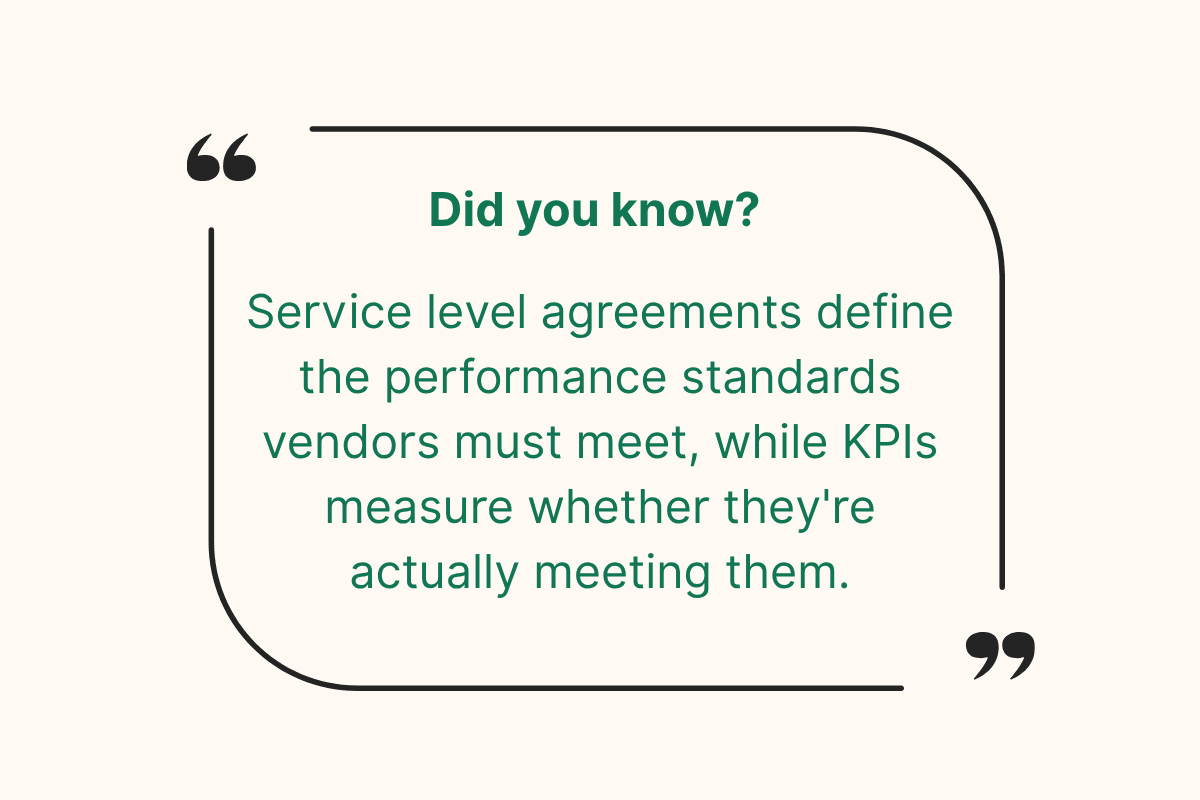
What are the different types of service level agreements?
Several types of service level agreements define how property teams and vendors structure their working relationships:
- Customer-based SLA: A contract between a property management firm and an external vendor that defines performance standards tailored to that specific client's requirements
- Service-based SLA: An agreement that defines performance standards for a specific service delivered to multiple customers
- Internal SLA: A performance agreement between departments within the same organization
- Multilevel SLA: A layered agreement that covers multiple vendors or service tiers, such as when a property firm sets different performance standards for preventive maintenance vendors versus emergency repair contractors.
- Operational SLA: An agreement focused on daily operations like system uptime and maintenance scheduling, commonly used for building compliance software and tenant portal availability.
What components are included in a CRE service level agreement?
A complete SLA is structured into defined sections that property teams, internal staff, vendors, and tenants can reference throughout the service period:
- Agreement overview: Summary of services provided, parties involved, contract duration, and the purpose of the SLA
- Stakeholder breakdown: Roles and responsibilities for property teams, internal staff, vendors, and escalation contacts for incident reporting software
- Service description: Detailed scope of services covered, including system integrations and any dependencies
- Performance metrics and targets: Specific service level agreement KPIs such as response times, resolution windows, uptime percentages, and quality standards tracked through service level agreement metrics
- Measurement and reporting: How performance data is collected, how often service level agreement reports are generated, and who receives them
- Exclusions: Services or circumstances not covered by the agreement, such as downtime during scheduled maintenance windows or force majeure events
- Security and compliance protocols: Data protection standards, compliance requirements, and nondisclosure agreements
- Remedies and penalties: The repercussions when service standards are not met, plus escalation procedures
- Indemnification clause: Provider agreement to compensate the customer for third-party litigation costs resulting from service breaches
- Review and adjustment process: Schedule for revising terms as operational needs and property management KPIs evolve
- Termination terms: Conditions allowing either party to cancel before expiration and required notice periods
What are typical CRE service level agreement examples?
Service level agreements in sustainable property management establish clear performance benchmarks for the operational services that keep buildings running and tenants satisfied.
Why are service level agreements important for CRE operations and tenant experience?
Commercial real estate teams depend on consistent service delivery to maintain tenant satisfaction and building performance - everything from predictive maintenance to resource reservation. Tracking vendor performance requires extracting data from multiple systems to build service level agreement reports, and most SLA software lacks flexibility to account for circumstances affecting completion times. Vendors often inherit outdated SLAs that no longer align with current operational needs, creating accountability gaps.
Despite these challenges, well-structured SLAs deliver measurable operational benefits:
- Consistent tenant experience across portfolios, regardless of which building or team handles requests
- Clear accountability for internal property teams and external vendors meeting the same performance benchmarks
- Better resource allocation when response time requirements guide staffing decisions and work prioritization
- Continuous improvement when service level agreement reports identify performance patterns supporting adjustments as building operations and tenant needs evolve
Note that the enforceability of service level agreements depends on contract language, with customers typically seeking binding terms, while vendors prefer non-binding commitments to avoid default risks. According to commercial litigation analysis from Edelboim Lieberman, many contracts incorporate good-faith effort clauses that allow substantial failures to justify breach claims, or bind vendors to a small set of clearly defined metrics with specified remedies.
What are some best practices for using service level agreements in CRE?
Effective SLAs require strategic design that balances operational priorities and tenant needs with practical vendor accountability.
Align SLA metrics with actual building operations priorities
Set response requirements based on whether an issue makes a space unusable or unsafe versus merely inconvenient. A malfunctioning door lock that prevents tenant access requires immediate response, while a slow-draining sink can wait until the next business day. Track these priority levels in service level agreement software so vendors understand which situations demand emergency dispatch versus standard scheduling.
Design SLAs with end-user needs at the center
Build service commitments around what maintains or improves tenant experience rather than vendor convenience. If tenants expect work order status updates within the same day they submit requests, require vendors to provide those updates even when repairs take longer to complete. Focus SLA requirements on the touchpoints tenants notice and care about, ensuring performance standards directly support satisfaction and retention.
Use clear, measurable terms that all stakeholders understand
Precise language eliminates disputes because everyone interprets the same metric identically. Replace "respond promptly" with "acknowledge within 15 minutes and dispatch within 2 hours" to avoid misunderstandings about what constitutes compliance. Specify how uptime is calculated, whether scheduled maintenance counts against availability guarantees, and what documentation vendors must provide in service level agreement reports.
Build in regular review cycles to keep SLAs current
Schedule annual or biannual contract reviews where both parties assess whether the original response times still match current needs. If building automation now detects equipment failures before tenants notice, response windows can extend. If tenant expectations have risen due to market competition, commitments may need to tighten. Write these review dates into the contract so neither party has to initiate an uncomfortable renegotiation conversation.
What do service level agreements look like with Visitt?
Visitt tracks SLAs as internal performance metrics that automatically apply time expectations to work orders based on category, priority level, or asset class. When a tenant submits a service request through the tenant portal, the system automatically assigns the appropriate SLA, ensuring consistent service standards across portfolios.
Teams configure SLA rules across five priority levels, ensuring emergency repairs get faster response commitments than routine requests. SLAs measure how quickly work is handled against service standards and working hours, serving as the higher-level performance benchmark compared to task-specific due dates. This creates clear accountability for response times that property teams can track to identify performance gaps and make relevant improvements.
See what smarter SLA software solutions can do for your portfolio.