The Tenant Portal: Changing the Way Buildings Handle Service Requests
Key takeaways:
- A tenant portal is a web or mobile platform that provides tenants with 24/7 self-service access to building services, lease information, and property team communication.
- Tenant portals reduce administrative workload and improve satisfaction by organizing service requests, payments, and communication in one system that property teams can track and measure against retention metrics.
- Visitt's tenant portal delivers the highest engagement in CRE: one chat-style app for fast requests, visitor registration, room bookings, and building news, all flowing directly into your operations platform.
What is a tenant portal?
A tenant portal is a web-based platform or mobile application that provides tenants with 24/7 self-service access to their rental account and building services. Tenants log in with personalized credentials to:
- View financial balances
- Submit maintenance requests
- Access lease documents
- Pay rent
- Directly communicate with property teams
The portal is a type of tenant communication tool that integrates with a range of PropTech solutions, including AI property management software, work order management systems, CMMS platforms, and accounting tools, creating an organized reference for maintenance, billing, compliance, and tenant experience purposes throughout the tenancy.
Common tenant portal software features include:
- Service requests with photo uploads and priority levels that route into maintenance management software
- Online payment processing with automated receipts and balance tracking
- Digital lease signing and document management for contracts, tenant insurance certificates, and other paperwork
- Real-time work order status visibility
- Building and safety announcements filtered by location or lease type
- Resource reservation tools for shared spaces and amenities
- Organized tenant communications threads that replace data silos
- Account management for contact details and notification preferences
Who uses property management tenant portals in commercial real estate (CRE)?
Commercial tenant portals connect office, retail, multifamily, hospitality, industrial, and special purpose property stakeholders to important building operations and experience data:
- Tenants submit maintenance requests, pay rent and common area charges, access lease documents, reserve amenities, and track open service requests
- Property managers receive and route service requests, monitor SLA compliance, send building-wide notifications, process rent payments, maintain communication logs for each leased space, and track tenant satisfaction
- Facility managers track maintenance across portfolios, coordinate preventive maintenance schedules with tenant availability, measure response times against service level agreements, and generate operational reports
- Leasing teams onboard new tenants with digital lease signing, provide access to building information and amenities, and support tenant retention through organized communication
- Maintenance staff are assigned work orders, and can access asset history before completing and documenting the work
- Vendors and contractors confirm service appointments, upload completion documentation, and submit invoices tied to specific requests
- Property owners and investors monitor tenant payment history, review maintenance activity and costs, track occupancy and lease renewal rates, and assess building performance through property management KPIs
How do tenant web access portals work?
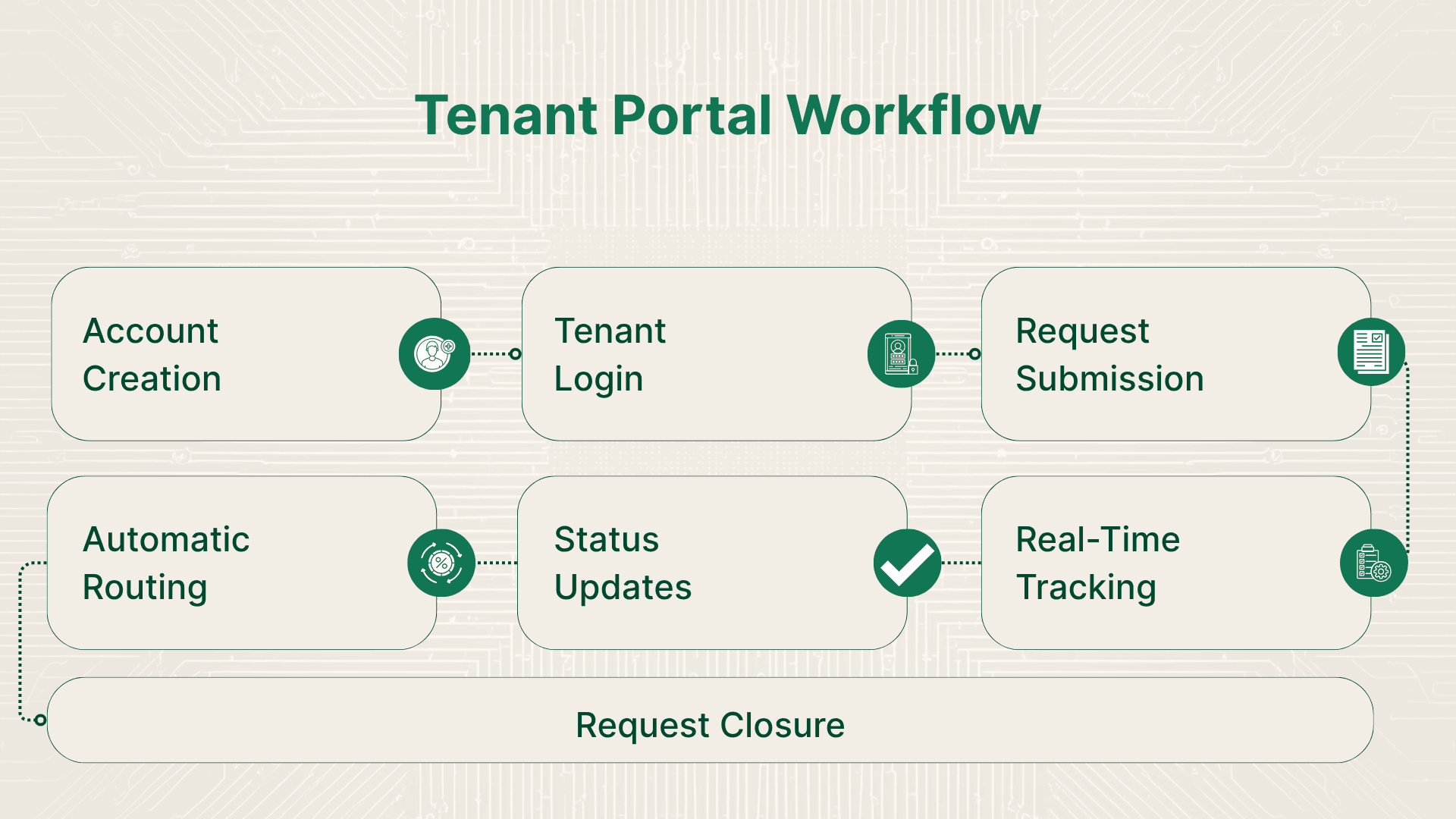
- The property team creates a tenant account linked to lease and unit details
- The tenant logs in to a personalized dashboard showing their balance, requests, and important documents
- Whenever it’s necessary, the tenant submits a service request with photos, description, and access preferences
- The request is routed to the relevant commercial real estate property management solution and stakeholder
- The system sends automated status updates as the request is handled
- The tenant views real-time progress without contacting the property office
- Requests close with resolution notes and timestamps visible to both parties
The role of AI in tenant engagement through commercial tenants portals
AI collects and learns from tenant data to coordinate work that could affect tenants' perceptions of their leases:
- Identifies the intent behind every submission: AI reads tenant entries to determine if they are requesting a repair, asking about a lease clause, or reporting a billing error, then instantly sends the request into the correct administrative workflow.
- Ensures requests are action-ready before submission: AI prompts tenants for missing site-specific essentials like suite access permissions, photos, or asset tagging details before the ticket can be finalized and sent to maintenance staff.
- Translates technical progress into clear status updates: AI monitors internal technician notes and automatically generates professional, tenant-friendly reports that explain what is being done and when the work will be finished.
- Flags tenant-billable items against the lease: AI cross-references portal requests with lease documents to alert the team if a service should be charged to the tenant or the landlord, preventing lost revenue and billing disputes.
- Clusters related tenant inquiries across the property: When multiple tenants ask about the same building issue or policy change, AI alerts management so they can issue one global update to the tenant app.
- Enables live multilingual communication inside the portal: Features like Visitt’s Live Translate let all parties write and respond in their preferred language while keeping one consistent conversation record directly within the platform.
- Automates the full accounts receivable cycle: AI tracks lease-specific deadlines to trigger personalized rent reminders and missed-payment notices, logging every automated touchpoint in the tenant's permanent portal history for total transparency.
Why are online tenant portals a must for CRE firms?
Research from the MIT Center for Real Estate found direct links between tenant satisfaction scores and lease renewals, rent growth, and vacancy rates. A one-point increase in satisfaction corresponded with an 8.6% higher likelihood of lease renewal, and at the portfolio level, a 10% improvement in satisfaction associated with 0.9% higher rent growth and lower vacancy rates. Property management quality ranked as one of the two strongest drivers of satisfaction, above location, amenities, and lease terms.
Meanwhile, Cushman & Wakefield’s What Occupiers Want 2025 report survey reflects how occupiers attempt to balance cost control with workforce engagement, recognizing that cost optimization loses value when it degrades employee experience. Property teams tracking financial metrics and people-focused outcomes like employee satisfaction and amenity usage through tenant web portals’ operations dashboards create the infrastructure for consistent, trackable communication between property teams and tenants, which leads to clear operational advantages:
- 24/7 self-service access to building information
- Digital lease signing and paperless documentation
- Automated payment reminders and notifications, leading to faster rent collection
- Shorter maintenance response times with better tracking
- Clearer maintenance expectations with photo uploads
- Streamlined vendor coordination and work order tracking
- Fewer inquiries about lease documents and payment records
- Centralized communication across team transitions
- Portfolio visibility into maintenance patterns
- Alignment between operations and tenant outcomes, leading to fewer complaints and more lease renewals.
How are tenant portals used in commercial real estate?
Tenant portals are used to support the core operational needs that drive commercial properties’ daily building management and tenant service initiatives.
How does Visitt’s tenant portal improve your tenants’ experience?
Visitt’s tenant portal works as one connected app that flows directly into your operations platform through the branded tenant portal app or web tenant portal:
- Submit service requests with photos in chat-style messaging
- Message property teams directly with real-time updates
- Pre-register visitors who receive branded invites with QR codes
- Schedule amenities like conference rooms, freight elevators, loading docks, and rooftop spaces
- Receive instant notifications when packages arrive at the front desk
- View building announcements, alerts, and events
- Track satisfaction through quick surveys when work orders close
Property teams interact with tenants through the same workspace they use for daily building operations, tracking engagement patterns that inform retention decisions. Built-in tools handle the coordination that typically requires manual follow-up:
- Announcements publish once and reach selected tenant groups across buildings
- Chat-style messaging keeps conversations clear and attached to the correct request or issue
- Automated status updates show tenants when requests are received, assigned, in progress, or completed without property teams sending individual messages
- AI categorizes incoming requests, flags recurring issues across properties, and routes maintenance requests to the correct workflow, improving response times
- Live Translate supports multilingual conversations without external tools, while the AI Rephrasing Tool helps teams send clear responses.