What is Document Management and How Does it Support CRE Operations?
Key takeaways:
- Document management creates continuity across the lifecycle of CRE assets, helping teams access and work from accurate and updated documentation.
- AI-driven document management learns from document history and context, so inspections, work orders, and compliance activity relies on verified records.
- Visitt embeds document management directly into building operations, keeping records connected to properties, vendors, and tenants so portfolio decisions are always evidence-based.
What is document management?
Document management refers to the systems and processes organizations use to:
- Create
- Capture
- Store
- Organize
- Access
- Secure
- Retrieve
- Review
- Update
documents throughout their lifecycle. It covers born-digital files and digitized records in many formats, along with the metadata and controls that keep those records usable, current, and traceable over time. This allows teams to work with information they can trust across systems and stakeholders.
In most organizations, document management is supported by a document management system (DMS), replacing scattered storage, manual tracking, and informal sharing with a structured document management workflow.
Typical document management system features include:
- Centralized, searchable document storage
- Version control with full history
- Role-based access permissions
- Audit trails for edits and approvals
- Review and approval workflows
- Retention rules and archiving controls
- Automated notifications and deadlines
- Secure document handling and encryption
- System integrations for connected workflows
The role of document management software in CRE
Commercial real estate (CRE) document management spans building operations, industrial property management, and CRE investor document management. Leases, contracts, inspection records, compliance documents, and operational files remain accessible and in context as assets change hands, requirements evolve, and portfolios grow.
Real estate document management software is used by:
- Commercial real estate property management teams to manage leases, amendments, commercial property inspection documentation, and files tied to day-to-day smart building operations
- Facility management teams to store operating procedures, permits, service documentation, and records connected to work order management, preventive maintenance, and equipment maintenance
- Finance and accounting teams to handle approvals, supporting documents for audits, and records tied to vendor invoice management and portfolio reporting
- Asset managers to review inspection histories, compliance documentation, and disclosures that support ongoing asset evaluation and capital planning
- CRE investors and owners to access documented records that reflect asset condition, regulatory standing, and long-term investment performance
- HR and operations teams to maintain employee records, onboarding documentation, and COIs
- Leasing and tenant-facing teams to manage contracts, disclosures, and documents shared through tenant communication tools
What to look for in AI document management solutions for your CRE firm
AI document management applies trained models to document content and metadata to identify document type, extract key information, and relate files to workflows. When AI evaluating AI document management solutions, firms typically focus on how well the platform supports portfolios at scale.
Key capabilities to look for include:
- Search and classification – OCR and AI-driven indexing that make scanned documents and PDFs searchable
- Workflow alignment – Integration with building operations, a CMMS, and resource management software
- Security – Permissions, encryption, and audit trails that support compliance and investor needs
- Configurability – Flexibility to support different document types, rules, and retention requirements
- Scalability – Performance that holds as document volume and users increase
- Future readiness – Support for AI property management software, connected PropTech platforms, and commercial real estate data analytics capabilities
How to implement your CRE firm's document management strategy
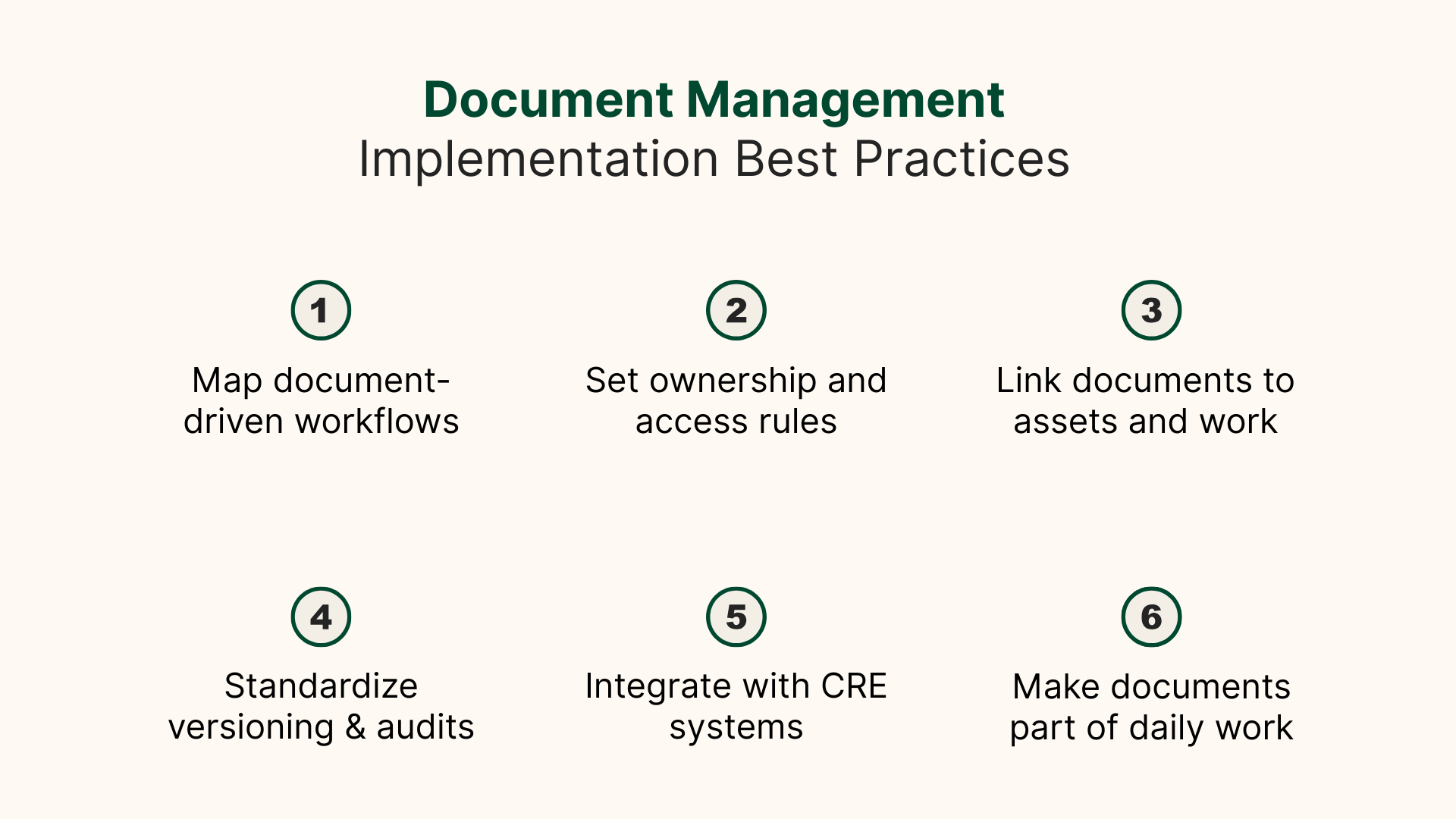
A document management strategy defines how documents support real workflows and decisions across the organization. CRE firms typically focus on:
- Identifying workflows where documentation directly affects outcomes
- Defining ownership, access rules, and approval responsibilities
- Connecting documents to properties, tenant operations, vendors, and work orders
- Standardizing version control and audit practices
- Integrating document management platforms with existing CRE systems
- Training teams to use document management tools
Why does your CRE firm need smart document management tools?
Commercial real estate runs on paperwork. Every asset generates a growing body of leases, amendments, inspection reports, permits, insurance records, invoices, and regulatory filings that continue to change long after acquisition and as portfolios expand. That friction positions document management systems as core infrastructure, with the global DMS market reaching $8.96 billion in 2024 and projected to grow to $16.66 billion by 2029 at a 13.4% CAGR.
For CRE firms, the risk of not implementing smart document management compounds over time. Documentation gaps delay inspections, weaken insurance validation, and erode confidence during refinancing, audits, or asset reviews. As firms layer automation and analytics into operations, smart document management provides continuity across years of asset activity, directly informing whether an asset still deserves capital or should be exited.
How do CRE teams currently use document management software?
Document management software shows its value where documents directly affect risk, timelines, and decision-making. CRE teams rely on document management systems to support repeatable workflows tied to assets, leases, vendors, and investors, especially when documentation changes over time and must stay verifiable.
Tracking document versions and approvals across teams
Document management is used to make sure property teams act based on the correct requirements and approvals. When work orders are created for maintenance, inspections, or vendor work, teams reference the latest approved documents, such as permits, COIs, inspection reports, and operating procedures, stored in the document management system. Version history ensures technicians and managers see the documents that apply to the work at hand, avoiding delays, rework, or compliance issues caused by outdated records.
Searching across documents for operational context
The latest document management systems use OCR and smart document management techniques to make scanned files and PDFs searchable. CRE teams use these capabilities to locate clauses, references, or compliance terms across multiple documents tied to a property or portfolio. Contextual, AI-driven search helps teams connect documentation to related operational or financial needs, informing next steps for the portfolio and its assets.
Securing collaboration without losing control
Across commercial real estate property management initiatives, document management software supports collaboration while protecting sensitive information. Role-based access ensures tenants, vendors, property teams, and investors only see documents relevant to them. Those with the relevant permissions can make comments and annotations, receive workflow notifications, and confirm approvals within the document management workflow. In this way, the PropTech helps reduce data silos, keeping discussions, decisions, and source records connected.
Managing leases, contracts, and amendments at the asset level
Real estate document management software is commonly used to manage leases, amendments, and vendor contracts that are updated throughout a property's lifecycle. Documents are stored within a document management system and linked to the relevant building, tenant, or vendor, allowing teams to track active terms, historical versions, and approval records. When lease clauses change or agreements are renegotiated, version tracking preserves what was valid at each stage, creating a single source of truth for dispute resolution and asset reviews.
Supporting compliance, inspections, and regulatory readiness
Commercial real estate document management supports compliance workflows tied to BOMA standards and recurring commercial property inspections by keeping required documentation connected to each asset and vendor. Inspection reports, COIs, permits, and regulatory records are managed within a document management system where expiration dates, document status, and version history remain visible over time. The DNS can also integrate with broader building compliance software, incident reporting software, and risk management workflows, reducing last-minute gaps, supporting consistent reporting, and helping teams demonstrate adherence across properties and portfolios.
Enabling CRE investor document management and due diligence
CRE investor document management relies on structured access to operating reports, CRE investor document management is used to evaluate whether individual assets continue to justify capital allocation within a portfolio. Investors review inspection records, compliance documentation, and historical disclosures stored within a document management system to understand how an asset's condition, regulatory standing, and risk profile have evolved over time. Version history allows comparisons across reporting periods, helping investors make informed decisions about holding, reinvesting in, or offloading assets.
What does document management look like with Visitt?
Visitt's document management solutions are built into your CRE firm's daily building operations. All operational, regulatory, and third-party documents are centralized in one system and linked to the relevant property, tenant, or vendor, so teams always understand the context behind each file.
Because document status and history are always visible and color-coded, teams can respond quickly when documentation changes or expires, rather than discovering issues during audits or inspections. Files can be updated as requirements shift, while earlier versions remain available to show what was valid at a given point in time. This structure helps teams stay aligned as documentation changes over time, supporting recurring compliance and operational processes across shared portfolios.
See what AI-driven document management can do for your portfolio