What is Maintenance Management Software? How CRE Teams Coordinate Repairs and Preventive Work
Key takeaways:
Maintenance management software centralizes work orders, preventive maintenance schedules, asset records, and vendor information so property teams can plan repairs and track completion across portfolios.
CRE teams need property management maintenance software to prevent surprise equipment failures that disrupt tenant operations and strain maintenance budgets across multi-property portfolios.
Visitt's AI detects patterns in maintenance data, identifies recurring issues, and monitors trends to alert teams before minor problems escalate into costly failures across commercial portfolios.
What is maintenance management software?
Maintenance management software is a digital platform that brings together information related to maintenance activity within buildings, so teams can identify, plan, track, and document the work required to keep assets operating in real-time.
For commercial real estate (CRE) teams, this information spans:
- Scheduled preventive maintenance tasks and inspection requirements
- Inspection findings and corrective actions
- Active work orders, from assignment to completion
- Vendor contracts and service agreements
- Regulatory documentation
- Maintenance history and field documentation
- Equipment performance trends and failure patterns
- Safety incidents and compliance violations
- Maintenance spend and billing information
- Capital planning data tied to equipment condition and replacement forecasts
To achieve this goal, common facility maintenance asset management software features include:
- Work order management that assigns tasks, tracks progress, and documents completion
- Preventive maintenance scheduling tied to time intervals, usage patterns, or asset conditions
- Asset tagging systems and document management with asset maintenance histories and performance data
- Inventory and spare parts tracking
- Mobile technician workflows for field maintenance teams
- Reporting that surfaces maintenance spend, completion rates, and equipment reliability
- Integration with AI property management software and building access control platforms
- Vendor invoice management
- Incident reporting software
- Operations dashboards connected to property management KPIs
- Commercial real estate (CRE) data analytics
Maintenance management vs. maintenance management software
What are the main types of maintenance management software?
Different platforms handle different aspects of facility management, from daily work coordination to long-term asset planning.
- Computerized Maintenance Management System (CMMS): Centralizes maintenance data and processes in a single system of record that manages asset records, work orders, preventive maintenance schedules, inventory, and compliance documentation. A CMMS acts as the hub where every task, asset, and part related to facility maintenance gets logged and tracked across properties.
- Enterprise Asset Management (EAM): Tracks assets through their entire lifecycle from purchase and installation to operation, maintenance, and eventual replacement. EAM systems offer deeper asset performance data and support capital planning decisions, which makes them useful for organizations managing large portfolios.
- Asset Performance Management (APM): Watches asset health in real time using condition data, IoT sensors, and analytics to predict failure risk. APM tools help teams move from reactive fixes to predictive maintenance, especially for critical equipment like HVAC systems or elevators where downtime directly impacts tenant experience and operating costs.
- Facility Management Software: Covers building operations beyond maintenance, including space management, commercial property inspections, vendor invoice management, and building compliance tracking. For commercial real estate portfolios with multiple locations, facility management software creates a single view of operations that ties maintenance work to broader commercial real estate property management workflows and resource management.
How does building maintenance management software work?
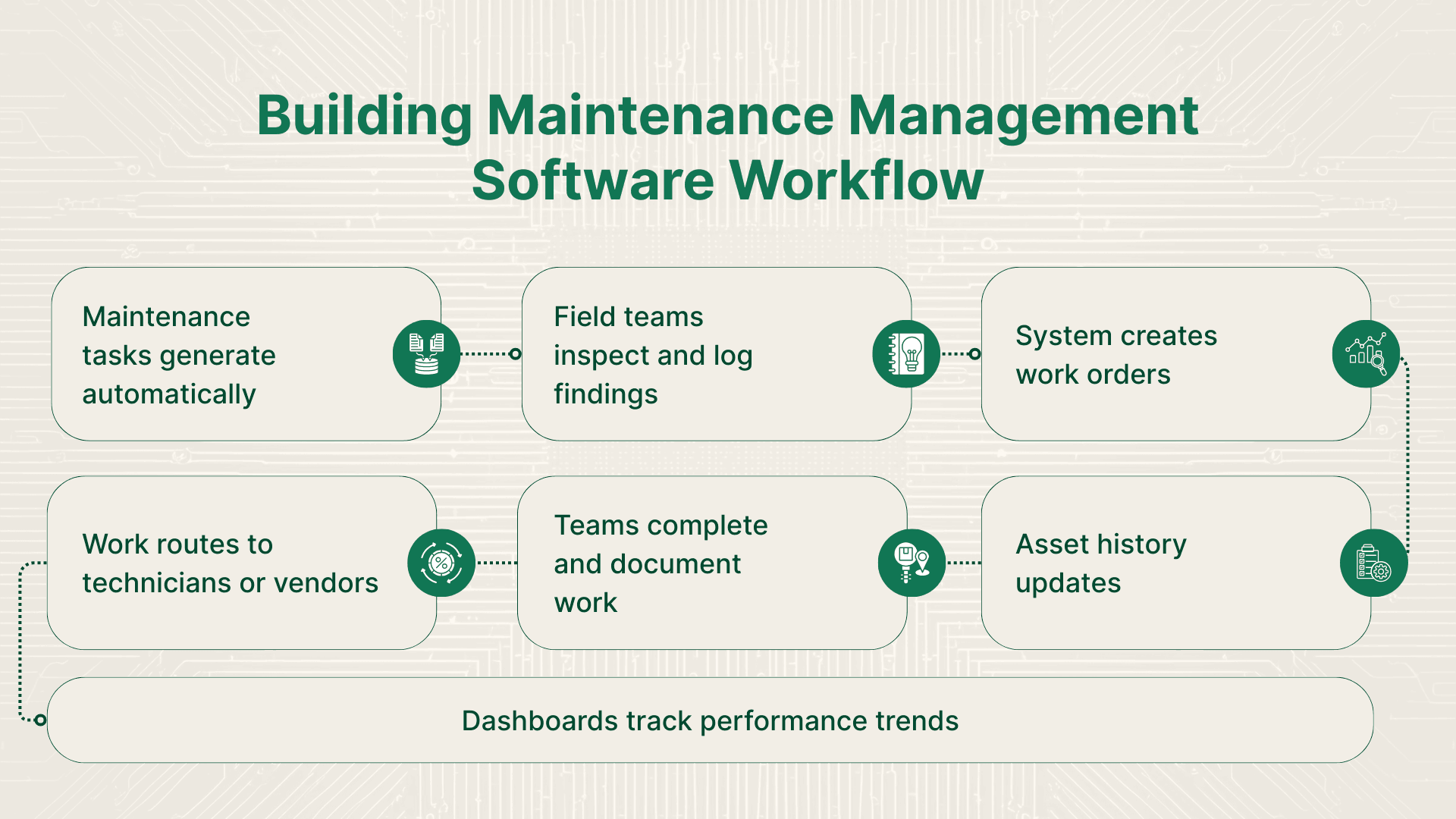
Building maintenance management software connects building operations across entire portfolios through a workflow that ties scheduled maintenance to inspection data, repair coordination, and asset performance tracking:
- The platform generates maintenance tasks automatically based on time intervals, usage metrics, or condition triggers tied to specific assets across the portfolio.
- Field teams complete commercial property inspections and scheduled maintenance, logging findings directly into the system to capture asset condition, deficiencies, and observations.
- Property management and maintenance software automatically generates work orders based on issue severity, predefined thresholds, or manual review by facility managers
- Work orders route to maintenance technicians or vendors based on trade specialization, location, or contract terms stored in the contract management software.
- Technicians receive assignments through mobile workflows, complete the work, and document what was done, parts used, and time spent.
- Completed work updates asset lifecycle tracking and builds maintenance history that refines future preventive maintenance schedules
- Teams monitor performance through dashboards that reveal operational trends and inform budget decisions
Why do CRE teams need property management maintenance software?
Commercial real estate portfolios lose significant operating income to reactive maintenance and unplanned downtime, costs that strain budgets across multi-property operations. A 2024 State of Industrial Maintenance Report found that 64% of facilities spend up to 20% of their annual operating budget on maintenance, with another 20% dedicating even more. For property teams managing aging mechanical systems, rising tenant expectations, and tighter operating margins, these numbers represent a structural challenge that manual coordination methods cannot solve at scale.
But there is a silver lining. According to an in-depth report from Siemens, Fortune 500 businesses that switch to proactive maintenance practices could reduce their combined equipment downtime by 2.1 million hours annually, achieve a 5% increase in facility productivity, and reduce maintenance costs by 40 percent.
Best maintenance management software use cases for CRE
Property teams use maintenance management software to implement building operations best practices that reduce equipment failures and control operating costs, while complying with relevant requirements across commercial portfolios.
Coordinating preventive maintenance across properties
Facility maintenance management software schedules recurring tasks that keep building systems operating within manufacturer specifications through practices that include:
- Setting maintenance triggers tied to calendar dates, runtime hours, or usage cycles
- Assigning work based on trade specialization, location, and current workload
- Tracking completion rates to identify missed tasks that leave equipment vulnerable
- Adjusting service intervals based on performance data and failure patterns
Reducing unplanned equipment downtime
Building maintenance management software prevents surprise failures that disrupt tenant operations through practices that include:
- Analyzing work order histories to identify assets generating repeated service calls
- Monitoring performance metrics that indicate developing problems
- Flagging equipment showing abnormal patterns for inspection before failures occur
- Maintaining spare parts inventory for high-failure components
Controlling maintenance costs and vendor spending
Property management and maintenance software tracks labor, parts, and vendor invoices tied to specific work orders through practices that include:
- Comparing actual spending against budgets at asset, property, and portfolio levels
- Analyzing vendor performance to identify poor first-time fix rates
- Tracking warranty periods to exercise manufacturer coverage before expiration
- Reviewing parts inventory turnover to eliminate overstocking
Maintaining compliance and audit readiness
Asset management and maintenance software keeps teams prepared for regulatory inspections and lender audits through practices that include:
- Scheduling required inspections for fire suppression, elevators, and regulated equipment
- Storing certificates of insurance with automated alerts when coverage nears expiration
- Generating audit reports showing completed inspections and remediation work
- Tracking permit renewals with deadline notifications
Why do CRE teams choose Visitt for their building maintenance management?
Visitt is a centralized, mobile-first CRE property management platform that helps field teams schedule, assign, and manage recurring inspections and maintenance across properties with offline-ready mobile workflows for field teams. Technicians capture images, videos, QR scans, numeric readings, and custom forms that automatically generate work orders when issues are identified. This real-time data capture connects field observations directly to action, eliminating the gaps that typically exist between inspection rounds and repair coordination.
Meanwhile, Visitt’s AI detects patterns in maintenance data, identifies recurring issues, and recommends next best actions to improve response times and planning. Predictive maintenance intelligence monitors trends and alerts teams before minor issues escalate into costly failures, while real-time dashboards track performance across assets, teams, and vendors with automated escalations and threshold-based alerts. The platform stores COIs, manuals, certifications, and service histories in one searchable location with automated expiration reminders, and portfolio-wide benchmarking compares performance across properties to optimize scheduling, reduce operating costs, and extend asset lifespan. This proactive approach leads to faster issue resolution and more reliable building systems, promoting a more positive tenant experience.
See how Visitt's maintenance management platform supports your CRE portfolio.