Property Management Certifications: What They Are and Which Ones CRE Firms Need
Key takeaways:
- Commercial property management certifications demonstrate that professionals understand how leasing, asset value, financial performance, and regulatory requirements intersect while executing standardized operational processes across portfolios.
- Major certifications for commercial property include Certified Property Manager (CPM), Real Property Administrator (RPA), Facilities Management Administrator (FMA), Certified Facility Manager (CFM), LEED Accredited Professional, and Accredited Commercial Manager (ACoM).
- Visitt supports certification requirements by providing the operational infrastructure that generates documented inspection histories, work order tracking, and performance reporting certified property managers need.
What are commercial property management certifications?
Commercial real estate (CRE) property management certifications are formal credentials that verify a professional's ability to manage commercial real estate assets using recognized standards, processes, and operational controls. A property management certification demonstrates that a professional understands the intersection of:
- Leasing obligations
- Asset value
- Financial performance
- Regulatory requirements
In doing so, they provide CRE firms, owners, and investors with the ability to standardize management practices across portfolios through:
- Commercial property inspections that document site conditions and identify issues requiring attention
- Preventive maintenance planning that keeps building systems operating efficiently
- Vendor coordination that manages external service providers under clear performance expectations
- Risk management that protects asset value through compliance and operational oversight
- Tenant communications to maintain occupancy and support lease renewals
How are property management certification requirements fulfilled?
The requirements certified property managers and certified facility managers meet span daily commercial real estate property management operations:
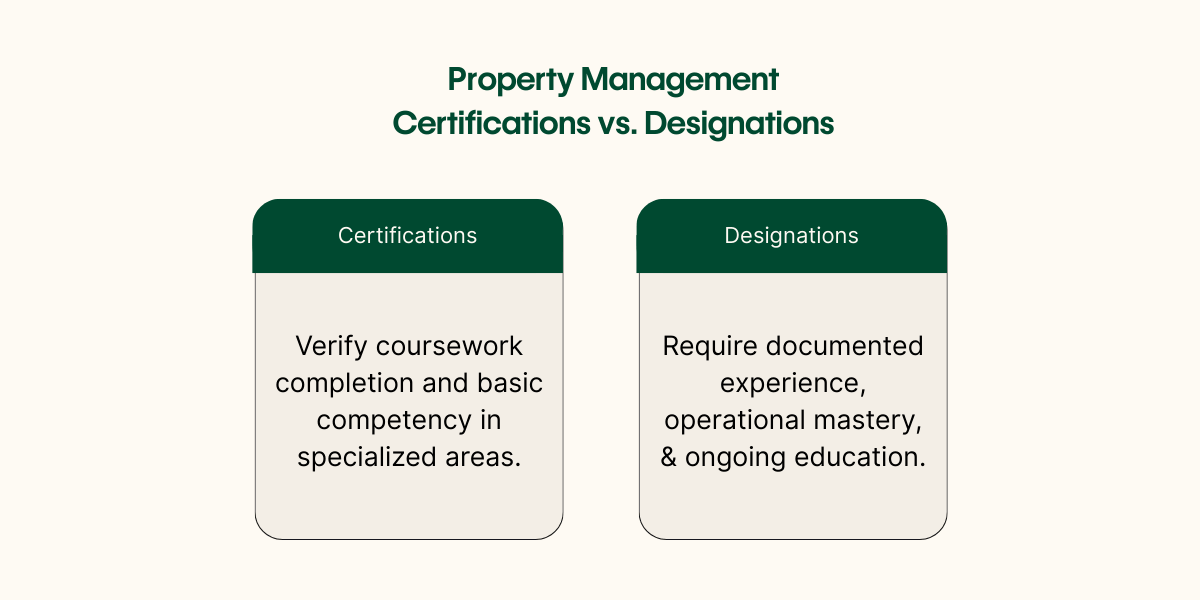
Property management certification vs. CPM designation
Property management certifications verify that a professional has completed specific coursework and meets basic competency requirements in areas like industrial property management, sustainable property management, or amenities management. They:
- Focus on specialized knowledge in particular aspects of property or facility management
- May require passing an exam
By contrast, a property management designation represents a higher-level credential that requires:
- A verifiable track record in managing commercial real estate assets
- Demonstrated mastery across multiple operational disciplines, including leasing, billing, maintenance, and compliance
- Continuing education and professional development
- Advanced operational competency recognition by institutional investors and lenders
Note: The Certified Property Manager (CPM) credential uses “certified” in its title but is classified as a professional designation because its rigorous requirements go beyond standard certification criteria.
Why are property management certifications important?
Professionals who obtain property management certifications or a certified property manager CPM designation demonstrate the competency that institutional investors, REITs, and third-party management firms evaluate when assessing property leadership and overall investment worth. These credentials validate that managers can execute the standardized processes, documentation practices, and oversight responsibilities that protect asset value and support portfolio performance.
From an organizational perspective, certifications create a shared operational language across teams and markets. Managing CRE assets requires consistent control over inspection, maintenance, financial, and compliance obligations. A commercial property management certification signals that these responsibilities are handled using documented methods that can be reviewed, audited, and scaled as portfolios grow, supporting:
- Stronger documentation for compliance reviews
- Clear accountability for vendors and internal teams managing complex assets
- Improved comparability across properties for budgeting and portfolio analysis
What are the major property management certifications in commercial real estate?
The certifications below represent the commercial property management certifications and designations obtained by CRE stakeholders.
- Certified Property Manager (CPM)
- Certified Manager of Commercial Properties (CMCP)
- Real Property Administrator (RPA)
- Facilities Management Administrator (FMA)
- Certified Facility Manager (CFM)
- LEED Accredited Professional (Operations + Maintenance)
- Accredited Commercial Manager (ACoM)
Certified Property Manager (CPM)
A senior-level property management designation (note: not a certification!) focused on managing commercial real estate at scale. The certified property manager designation, often referred to as the CPM designation, validates mastery across leasing strategy, financial analysis, maintenance planning, risk management, and regulatory compliance. It is widely recognized as the benchmark credential for professionals overseeing complex portfolios.
Provider: Institute of Real Estate Management (IREM)
Best for: Senior property managers, portfolio managers, asset managers, and leaders responsible for full commercial asset performance.
Requirements:
- Multiple years of qualifying commercial property management experience
- Completion of advanced coursework covering finance, leasing, operations, and ethics
- Submission of a management plan demonstrating applied competency
- Passing a comprehensive capstone assessment
Certified Manager of Commercial Properties (CMCP)
An entry-level property management certification designed for professionals managing commercial buildings with limited years of experience. It validates core competency in leasing support, maintenance coordination, risk awareness, and financial reporting, providing a structured on-ramp to more advanced certifications such as the RPA.
Provider: BOMA/BOMI International
Ideal for: Early- to mid-career commercial property managers building foundational expertise.
Requirements:
- Completion of a structured commercial property management course
- Passing a certification exam covering core operational topics
Real Property Administrator (RPA)
A commercial property management certification centered on how buildings operate as financial and physical assets. The program emphasizes budgeting, accounting, leasing, building systems, and risk controls that directly affect net operating income and asset value. RPAs are trained to apply owner-level thinking to daily building management decisions.
Provider: BOMI/BOMA International
Ideal for: Commercial property managers and asset managers focused on operational and financial performance of office, industrial, and mixed-use buildings.
Requirements:
- Completion of structured coursework covering law, finance, building systems, and asset management
- Documented commercial property management experience
- Adherence to professional and ethical standards
Facilities Management Administrator (FMA)
Focuses on the operational layer of commercial property management. This property management certification addresses how facilities teams plan preventive maintenance, manage work orders, control energy usage, and maintain safe, functional environments. The FMA aligns facility performance with organizational and tenant requirements.
Provider: BOMI/BOMA International
Ideal for: Facility managers and property managers responsible for daily building operations, maintenance execution, and occupant experience.
Requirements:
- Completion of facilities-focused coursework
- Demonstrated experience in building operations or facility management
- Application of safety, maintenance, and operational planning principles
Certified Facility Manager (CFM)
A competency-based commercial property certification that validates real-world expertise rather than coursework completion alone. The certification assesses mastery across operations, maintenance, finance, technology, sustainability, and leadership. CFMs are expected to manage facilities as integrated systems that support business continuity and long-term asset performance.
Provider: International Facility Management Association (IFMA)
Ideal For: Experienced facility managers overseeing complex building systems, projects, and cross-functional operations.
Requirements:
- Significant hands-on facility management experience
- Passing a comprehensive, scenario-based examination
- Ongoing continuing education to maintain the credential
LEED Accredited Professional (Operations + Maintenance)
A sustainability-focused professional credential designed for those operating and maintaining high-performing existing commercial buildings. The LEED AP (O+M) is classified as a credential, rather than a certification, because it verifies demonstrated competency through examination and ongoing continuing education requirements, not completion of a defined program. It validates advanced knowledge in optimizing building performance, including energy and water efficiency, indoor environmental quality, and waste management. It emphasizes ongoing performance tracking and decarbonization strategies for existing assets.
Provider: Green Business Certification Inc. (GBCI)
Ideal for: Facility managers, building engineers, and property leaders responsible for sustainable building operations, ESG reporting, and environmental performance oversight.
Requirements:
- Must be at least 18 years of age and hold a current LEED Green Associate credential.
- Passing the LEED AP Operations + Maintenance specialty exam.
- Demonstrated proficiency in the LEED v4.1 (or v5) rating system, building performance measurement (via platforms like Arc), and project documentation.
- 30 continuing education (CE) hours every two years. At least 6 hours must be specific to the O+M specialty.
Accredited Commercial Manager (ACoM)
A professional designation focused on operational execution within commercial property management. Positioned as an intermediate designation, it validates a manager's ability to apply standardized leasing administration, financial controls, and operational oversight across commercial assets. The ACoM is often pursued by professionals managing office, retail, or industrial properties who are progressing toward the Certified Property Manager (CPM) designation.
Provider: Institute of Real Estate Management (IREM)
Ideal for: Commercial property managers and assistant asset managers responsible for daily income-producing commercial building operations.
Requirements:
- Documented experience in commercial real estate property management
- Completion of IREM commercial property management coursework
- Submission of a commercial property management plan
How does Visitt support property management certification compliance?
Visitt supports Certified Property Manager (CPM), Real Property Administrator, and Facilities Management Administrator, and other certifications' requirements by providing the operational infrastructure enabling inspections, preventive maintenance planning, and issue tracking. On-site teams and CRE leaders pursuing commercial property management certification use Visitt to standardize processes across commercial property inspections and facility management workflows:
- Digital inspections capture site conditions with timestamped photos and notes that verify completed work.
- Work order management creates trackable chains of custody from issue identification to resolution
- Real-time reporting generates the documented operational history that certified property managers reference during credential renewals.
In doing so, they gain clearer visibility into vendor performance and issue resolution timelines, spend less time reconstructing documentation manually, and apply the same operational rigor across complex commercial assets as portfolios expand.