
Product Releases
Sep 30, 2026
How CRE Operators Prove ROI From Building Operations Software
Five steps to go from "it feels valuable" to a business case your buying committee approves.
Commercial real estate portfolios are scaling faster than the systems running them. And while work order management creates a feeling of control through logged tickets and completion rates, post-ticketing bottlenecks mask critical inefficiencies that only connected, AI-driven workflows can resolve at scale.
Commercial real estate (CRE) portfolios are scaling faster than the systems running them. JLL's 2026 outlook shows that 72% of CRE leaders now identify costs and budget efficiency as their top priority, while portfolios expand across more buildings, more markets, and more complexity than teams have managed before. At the same time, smart buildings are becoming standard. Demand for data centers remains strong in 2026, with preleasing of new construction consistently above 75% across primary markets, which means more data and exponentially more maintenance requests flowing into systems built when portfolios were smaller and buildings were simpler.
Work order management feels like it's working because tickets turn into tasks, and those tasks get assigned and completed. But what looks like control on an operations dashboard often masks the fact that the work order management process has become the hidden drag on costs, response times, and tenant experience that leadership teams can't see until it shows up as budget overruns or lease non-renewals.
Our team hears your frustrations over the accumulating tickets. But ticket volume is the least of your worries. It's what happens after the tickets are created.
The work order management process gives off a feeling of control.
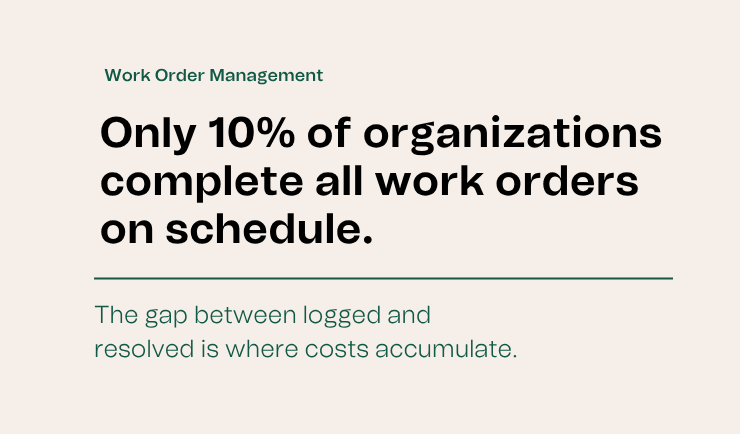
But none of that means that equipment maintenance is being taken care of faster or tenants are any more satisfied with how long it takes to resolve their issues. While nearly 60% of facility managers saw increased work order volume in the last year, facility management teams spend a significant portion of their time on administrative work order processing rather than preventing equipment failures or addressing tenant concerns. This explains why only 10% of organizations report that all tasks are completed on schedule.
The metrics look good while inefficiency persists:
A closed ticket tracks completion, not efficiency, and the gap between the two is where costs accumulate and tenants get frustrated.
Creating tickets takes minutes. Processing them takes days.
The maintenance work order process flow follows a standard path from identification through completion, and at every step, manual handoffs slow resolution and disconnected systems fragment visibility:
The problem is that each step operates in isolation:
They need connected work management process flows that integrate teams, vendors, compliance requirements, amenity bookings, and tenant communications into intelligent operations.
Work order processing software built for connected workflows:
Research shows that workflow automation can reduce cycle times by 77% when manual steps are removed, yet as portfolios scale and buildings generate exponentially more maintenance requests, teams still coordinate through email chains and disconnected systems watch resolution times stretch, essentially making them redundant.
At the end of the day, work order processing is much bigger than the mere act of logging tickets or tracking completion rates. At its core, its steps and activities all work to protect the business outcomes that determine whether portfolios grow or struggle.
BusinessWire confirms that companies using connected work order processing software experienced an average 20% reduction in material costs and equipment downtime by automating assignments, streamlining submissions across teams, and surfacing trends that manual review misses:
Protecting these outcomes at scale is what separates work order operations from back-office task management.
The market is moving toward AI-driven, automated platforms that turn systems of record into systems of action. It is now more than clear that staying with reactive, disconnected work order processes limits growth while competitors use intelligent workflows to cut response times, improve tenant satisfaction, and operate more efficiently at scale.
Which side of the balance will your firm be on? The decision is yours.
Visitt's Work Order Intelligence makes the shift to connected systems of action possible, turning task tracking into building operations that protect NOI and keep tenants from leaving over unresolved issues. Visitt builds on the gaps left by legacy PropTech tools, combining automation with AI to handle every part of the work order management process within a single platform:
If you’re ready to stay one step ahead of your day-to-day operations, talk to our team and explore how we can work together.
A work order management process tracks how maintenance requests move from creation to completion. It includes how requests get logged, assigned to the right team member, prioritized based on urgency, executed in the field, and documented for future reference. This creates a paper trail for compliance, warranty claims, and disputes. It also helps identify patterns like recurring issues in specific units or buildings, enabling proactive maintenance planning.
The bottleneck happens after logging. Someone has to review the request, assess its urgency against other open work, decide who should handle it based on skill set and availability, coordinate building access with the tenant or property manager, and track the repair through to completion. Each of these steps involves communication, decision-making, and handoffs between people. When you're managing multiple properties or a large portfolio, coordination becomes exponentially harder.
Work order processing software automates the steps between creating a request and finishing it. It tracks every stage of the repair process, sending automated updates to tenants so they know their request is being handled. For property managers, the software provides real-time visibility into open requests, completion rates, and technician performance. It also centralizes documentation, making it easy to pull records for audits, warranty claims, or tenant disputes. The result is faster resolution times, less administrative overhead, and fewer issues slipping through the cracks.
Tenants care about how fast issues get resolved, not how fast they get logged. Tenants want to know their request was received, when someone will address it, and if there are any delays. Efficient work order management automates that transparency. It also ensures requests don't get forgotten or deprioritized, which is often what drives the most frustration. When tenants see that maintenance issues are handled promptly and professionally, they're more likely to renew their leases and recommend the property to others.
Yes, in several direct ways. Efficient processing reduces emergency repair costs by catching maintenance issues before they escalate. Better work order management also prevents tenant turnover driven by unresolved maintenance frustrations. Losing a tenant costs far more than fixing their issues promptly. Between vacancy loss, marketing expenses, unit turns, and concessions for new tenants, turnover can easily cost one to two months of rent per unit. Streamlined work order processing keeps tenants satisfied and reduces the operational waste that erodes NOI.


Insights, trends, and practical ideas for smarter commercial real estate operations.

Discover how Visitt transforms operations and tenant
experience, portfolio-wide.