Blog posts

CRE Technology Works Better When it Works Together

Your CRE tech stack probably has enough tools. What it needs is to act like one system.
By
Team Visitt
Released
Sep 15, 2026
Last update
Oct 12, 2026
Property Operations

TL;DR

  • Most property teams already run plenty of Commercial real estate technology, spread across tools that never share what they capture.
  • Connecting that stack through integrations gives every system one operational record to draw from, so your teams finally work from the same data.
  • Visitt is AI-native building operations software that connects the proptech and building systems you already run, bringing visibility and control across your whole stack.

Property teams rarely suffer from too little CRE technology. The typical portfolio runs a stack of it, one tool for leasing, another for maintenance, a third for tenant experience, and a few more for reporting and compliance. Each one does its job. The trouble starts in the space between them, where the data each tool captures never quite reaches the others.

Forrester puts the time knowledge workers spend searching for information at nearly 30% of their day, much of it lost to disconnected systems built on legacy tech and one-off tools. In real estate specifically, IREM reports that 58% of mid-sized firms still run legacy systems incompatible with modern integrations, with disconnected workflows and data silos flagged as the biggest drag on operations.

So, the real question is how to get the tools you already run to work as one, which is why integrations become non-negotiable once you're running a portfolio at scale.

How did the CRE technology stack get so fragmented? 

The fragmentation traces back to how CRE software gets bought, which is one problem at a time:

  1. A team adopts an accounting platform; 
  2. Adds a separate tool when leasing outgrows spreadsheets;
  3. Brings in another for maintenance;
  4. Then a tenant app once residents expect one. 

Because no system holds the full picture, data has to be re-entered as it moves between tools, and every manual transfer adds delay and room for error. It also caps what AI can do, because a model can only reason over the data it can reach, and in a fragmented stack, most of that data stays trapped in tools that were never built to connect. Closing that gap is the work of property management software integrations, which give commercial property management software a single connected record to draw from. 
Where connected CRE technology creates value 

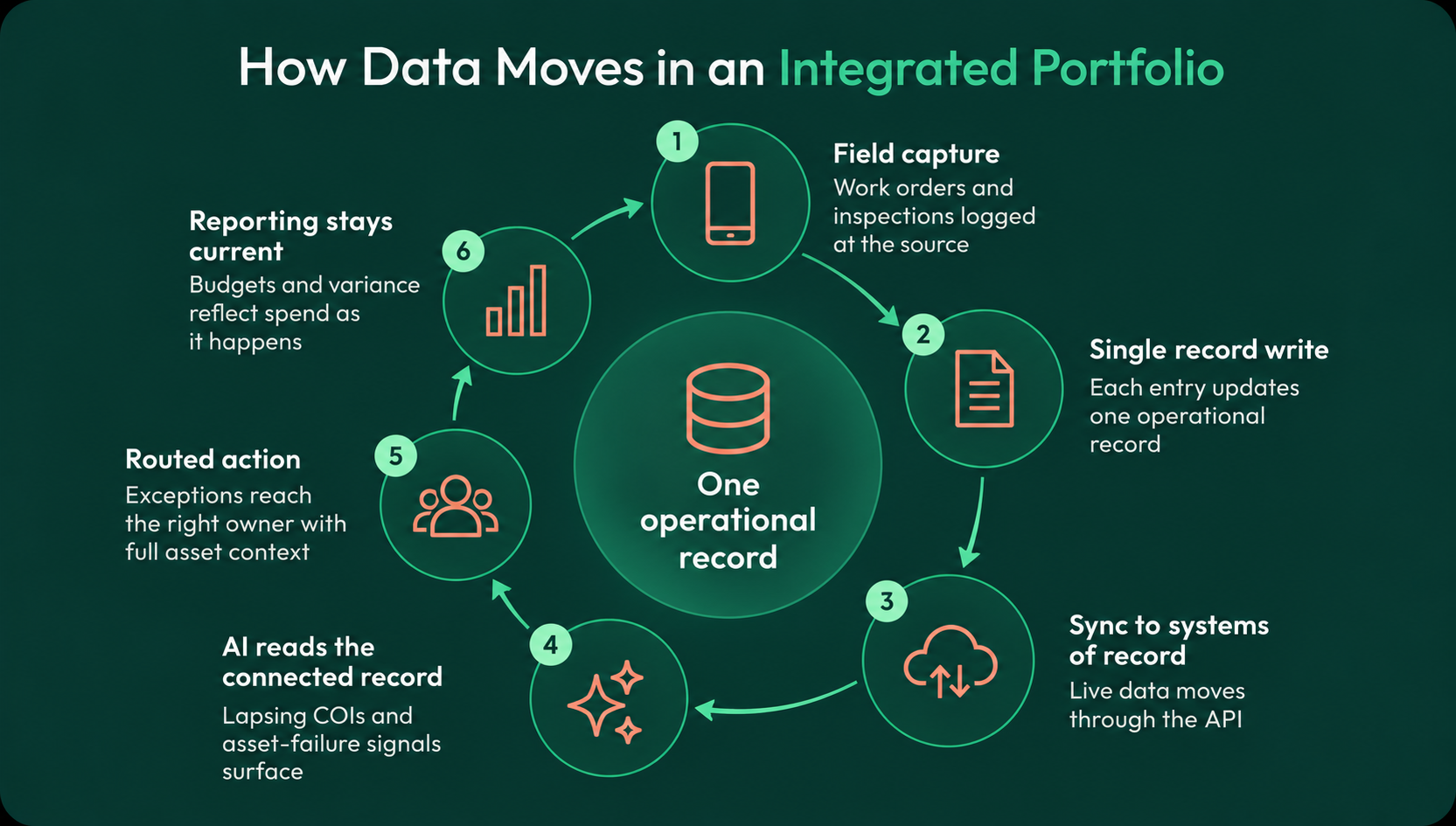
How Data Moves in an Integrated Portfolio

Connecting your commercial real estate technology changes what the stack can do. Once operational data moves freely across the systems you run, three things become possible:

A single source of operational truth 

A connected stack runs on one operational record instead of many. When building operations software sits at the center, the day-to-day work writes to the same place the accounting core reads from:

  • Work orders, inspections, preventive maintenance, and tenant communications update one record, so a technician closing a repair in the field updates the exact data finance pulls at month-end
  • Connected building systems collapse duplicate vendor records, giving each vendor one COI status and one work history every team reads the same way
  • That shared record becomes the input for every downstream decision, from a budget line to a lease renewal

AI with the context to act 

The AI in your commercial real estate technology is only as good as the data it can reach, and a connected stack is what gives it something to work with: 

  • A model wired to one siloed feed can only describe that fragment, while CRE proptech running on connected data reasons across the whole operation
  • The operational context lets it trace a repeat work order back to the failing asset behind it and catch a vendor whose certificate lapses before a scheduled job
  • That same context lets AI predict equipment failure early enough for the team to plan around it instead of reacting to it

An extended stack through integration

To extend the stack is to make each tool more useful by connecting it, so a Yardi integration turns Yardi from a closed accounting system into one fed by live field activity, and a CMMS integration pushes asset and work-order history into the same record your budgets and inspections draw from.

Fragmented stack Connected stack
Data visibility Each tool holds a partial view; no system sees the whole property One operational record every system draws from
Adoption Extra logins and manual entry push teams back to workarounds Work happens once, in the flow teams already use
Insight Reporting means reconciling numbers across platforms Patterns surface automatically across the portfolio
Vendor records The same vendor recorded three ways across three tools One vendor, one COI status, one work history

How a fragmented CRE technology stack compares to a connected one across data visibility, adoption, insight, and vendor records.

Dos and don'ts for integrating your CRE technology

An integration succeeds or stalls based on how you scope it, before a single system gets connected: 

The dos

  • Do tie every integration to a result. Connect a tool because it closes a compliance gap or speeds a workflow like lease abstraction. An integration scoped to an outcome gives you a way to measure whether it worked.
  • Do bring ops, IT, and finance in early. Ops owns the field activity, finance owns the system of record, and IT owns the API and security review. Aligning them before rollout settles field names and sync direction before they surface as mismatched data after go-live.
  • Do standardize your data inputs. Uniform field structures across every property are what make reporting and AI analysis accurate. Without them, a connected stack still produces mismatched records, and AI reasons over data it can't trust.
  • Do choose systems built to integrate. Prioritize commercial property management software with an open API and documented connectors to the platforms and building systems you already run. Native integrations survive version updates and portfolio growth.
  • Do favor systems built with AI at the core. A platform architected around AI reasons across your full operational record from the start, so insights and automation come standard instead of arriving as a later plug-in. Retrofitted AI only reaches the slice of data its host system holds.
  • Do pilot before you scale. Run the integration in one building or a portfolio subset first, measure it on workflow efficiency and adoption, and expand once it holds.

The don'ts

  • Don't add technology before auditing the workflow. Review how a process runs before wiring a new system into it. Connecting a tool to a workflow that already loses information at a handoff automates that loss across the portfolio.
  • Don't leave captured data unused. Building operations software logs work orders and vendor history without pause. If that data never routes into reporting or an AI model, you pay to capture it and get none of the operating leverage back.
  • Don't let fear of the lift stall adoption. Teams resist tools that feel like one more system to learn. The integration that gets used is the one that fits the workflows field staff already run, so onboard them on familiar ground and adoption follows.
  • Don't measure success by app count. The number of tools you've deployed says nothing about whether they work as one. Track integration by how much manual reconciliation disappears and how consistently teams work from the same record.

Choosy CRE firms choose Visitt to connect their stack 

Visitt brings the day-to-day work of running a property into one place. Built as AI-native building operations software, the platform reads your connected operational picture and acts on it, flagging the vendor whose coverage lapsed and the asset trending toward failure before either reaches a tenant.

And because it connects to the proptech and building systems you already run, that intelligence extends across your whole stack, giving you better visibility and control without replacing a thing.

If that sounds like an improvement on your current setup, talk to our team and explore how we can work together.

FAQ

  • What is CRE technology?

    CRE technology refers to the software and systems commercial real estate teams use to manage properties. It ranges from accounting and lease administration platforms to building operations software, and increasingly depends on connected data and AI to give property teams portfolio-wide visibility into performance and spend.

  • What's the difference between CRE software and building operations software?

    CRE software is the broad category that includes leasing and accounting platforms, along with asset management systems. Building operations software handles the operational layer, covering work orders and preventive maintenance. When building operations software integrates with the rest of the CRE technology stack, operational data automatically reaches the systems of record.

  • Can commercial property management software integrate with Yardi?

    Yes. Visitt is commercial property management software built on an open API, and it integrates directly with Yardi, syncing operational and financial data between the platforms automatically. This keeps Yardi as your system of record while layering Visitt's AI-native workflows for building operations on top.

  • Why do CRE technology implementations fail?

    CRE technology implementations usually fail for one of two reasons. The tool gets added on top of a workflow that was broken to begin with, so it digitizes the same problem. Or it can't share data with the systems already in place, which means the team keeps working around it and the software never earns real adoption.

  • What makes AI-native CRE proptech different from traditional tools?

    AI-native CRE proptech like Visitt is built with AI in the core data model. Because Visitt runs on connected building systems, it has the operational context to flag anomalies and predict asset failures early, turning live maintenance and vendor data into action across the portfolio.


  • Talk to our team!
    Book a Demo
    Share article

    Book a personalized
    product demo

    Discover how Visitt transforms operations and tenant
    experience, portfolio-wide.