
Product Releases
Sep 30, 2026
How CRE Operators Prove ROI From Building Operations Software
Five steps to go from "it feels valuable" to a business case your buying committee approves.
The vendor management strategy you implement ripples across your portfolio's performance and ROI.

Even the best-run CRE portfolios need to outsource to vendors, every once in a while. But doing so inherently introduces a certain degree of risk, as every vendor works outside the firm's direct oversight, on a property the firm is still responsible for.
This is particularly important given that NAI Global's 2026 risk management research found deferred maintenance to cost roughly four times more to address than the same work done on schedule, with vendor and contractor compliance named as one of the categories driving that cost.
Developing and implementing a real vendor management strategy across every property management vendor on the roster, is what keeps that risk as low as possible, while protecting the productivity of every property in the portfolio and the tenant experience that depends on it.
Can you say yours does?
Here are some vendor management best practices to fix your relationships with facility management vendors and their results, ASAP.
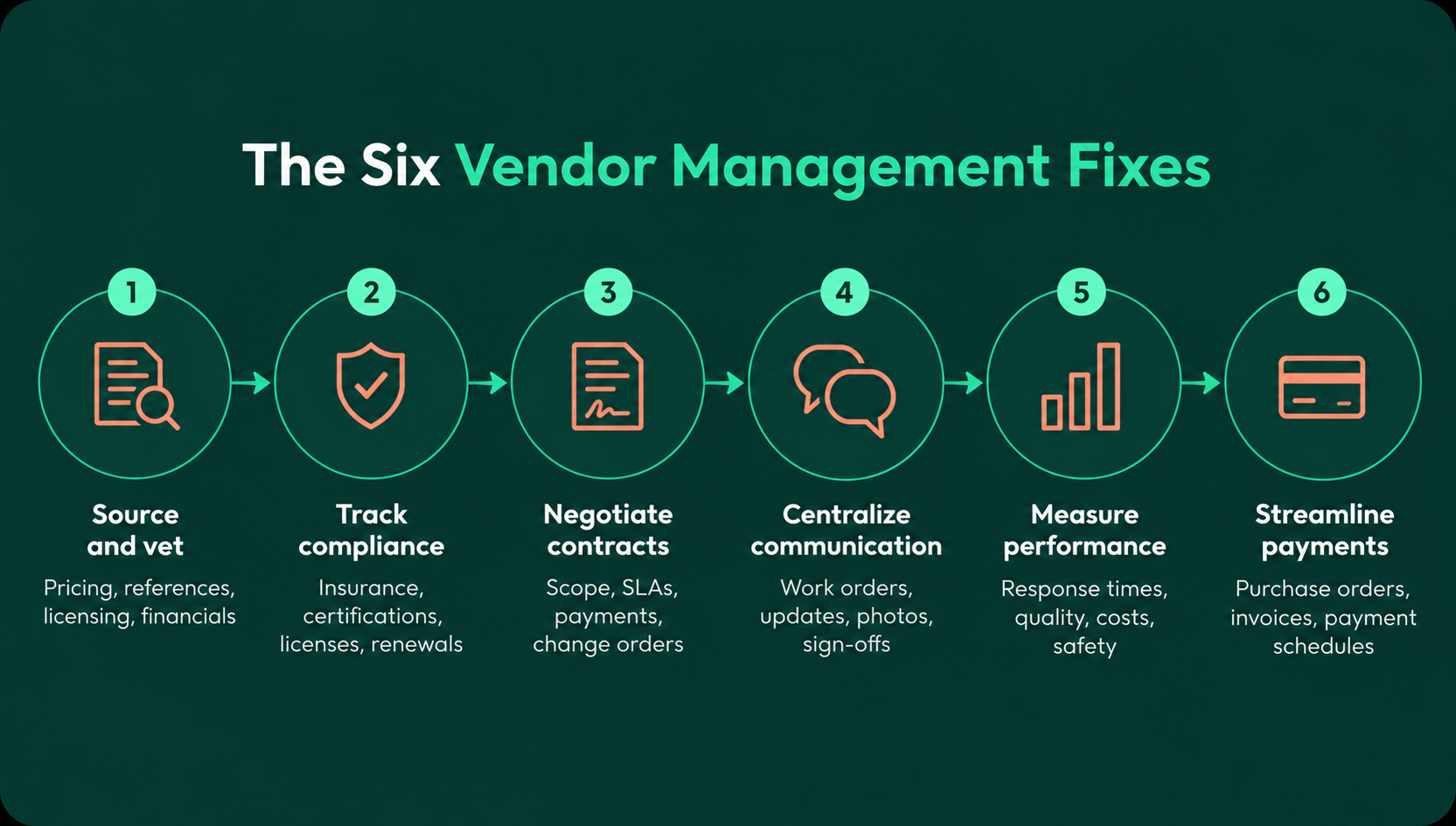
Price is the easiest thing to compare between vendors and the least useful predictor of how the relationship will go. A standardized pre-qualification process checks two things a bid alone won't: whether a contractor's crew can perform the work you need reliably, and whether they can do it at portfolio scale, when multiple properties need them at once.
Clearing pre-qualification once doesn't guarantee a vendor stays compliant for the length of the relationship. Licenses expire and coverage lapses, often without the vendor flagging it themselves. If something happens on-site while any of that has gone unnoticed, your firm may find itself exposed, which is why vendor risk management must include tracking with vendor compliance management software.
A vendor contract is there to protect both sides, at the moment of signing and at every touchpoint that follows. The clearer and more specific the vendor contract management, the more accountable everyone stays, and the better the relationship holds up over time.
The more siloed the tools, the harder it is to remain productive and accountable. Vendor management software solves this by making the property operations system the one source of truth for real estate vendor management, and that alone speeds up everything downstream for property management vendors and property teams alike.
What gets measured gets managed, and vendor performance is no exception. Ongoing tracking using a vendor management system tells a firm more about a vendor's reliability than a mid-project check-in ever will, and can even help surface digressions before they escalate.
Reliable payment protects the vendor lifecycle the same way a strong contract does, giving good vendors a clear reason to define vendor management as a two-way commitment and keep prioritizing a firm's work over anyone else's.
The best-run CRE portfolios share one advantage with their vendors, clear standards paired with consistent oversight, which is what keeps vendors performing at their best.
Visitt's vendor management capabilities bring that same standard into the platform, centralizing vendor management alongside the rest of property operations, so every vendor stays accountable and every process stays on track.
If your team is ready to give vendors the clear standards and consistent oversight that make strong performance possible, talk to our team and explore how we can work together.
Vendor management definition: how a property team sources and oversees the outside contractors and service providers working across its portfolio, covering vetting, contracts, and ongoing performance, ensuring every vendor on a property meets the standard the firm requires.
Maintenance, landscaping, security, cleaning, and amenity upkeep can all run through vendors. Clear requirements and consistent oversight mean fewer callbacks, fewer missed deadlines, and vendors who show up prepared, which directly impacts their performance and, by extension, tenant experience across the portfolio.
Yes. Leading financial and professional services firms like Deloitte put expected savings from strong vendor sourcing, meaning the right fit, the right price, and on-time delivery, in the 5% to 20% range. The same principle applies to CRE vendors: those who know they're being measured perform more reliably, which cuts down on emergency repairs and the costs that come with them.
Visitt centralizes vendor records, including contact details and trade notes, whether added individually or in bulk. Vendors get assigned directly to work orders, and all communication is saved automatically to that work order's history, without anything getting lost across email threads.
Yes. Visitt's optional COI tracking add-on monitors compliance status and coverage requirements, with automated reminders for vendors and alerts for staff. Visitt also integrates with VendorPM for broader vendor lifecycle management across compliance and operations.


Insights, trends, and practical ideas for smarter commercial real estate operations.

Discover how Visitt transforms operations and tenant
experience, portfolio-wide.