Product Releases
Sep 30, 2026
How CRE Operators Prove ROI From Building Operations Software
Five steps to go from "it feels valuable" to a business case your buying committee approves.
Five steps to go from "it feels valuable" to a business case your buying committee approves.
“How can CRE operators prove ROI from building operations software?”
This is one of the most common questions we hear from commercial real estate firms and operators. They want to know the ROI of their investment before they make it, which makes sense, but also makes it hard to prove.
Every firm's ROI depends on multiple factors, even when using the same AI building operations platform:
Deloitte's 2026 Commercial Real Estate Outlook surveyed over 850 C-level executives and found that 75% plan to increase their real estate investment over the next 12 to 18 months. That said, while the money is there, the patience for unproven spending is not.
There are clear ways to prove your investment in CRE property management software to investors and decision makers once it's integrated into your building operations. Here's what you need to do.
You cannot prove improvement without knowing where you started. Before you roll out any commercial real estate property management software, establish the KPIs you'll measure across the portfolio from day one.
Start with the metrics that connect most directly to cost:
Then capture the metrics that connect to tenant retention and portfolio performance:
Three to twelve months of data provide a reliable baseline for comparing pre- and post-CRE software implementation performance.
Next, convert those baseline metrics into dollars your finance team can evaluate against the cost of the commercial property management software and the projected savings of running more centralized, proactive CRE property management systems over time.
Once the software is live, track the same baseline metrics from Step 1 over the same time window. The difference between pre- and post-implementation performance is your measurable operational gain, while the revenue your team wasn't billing before is your recovered income.
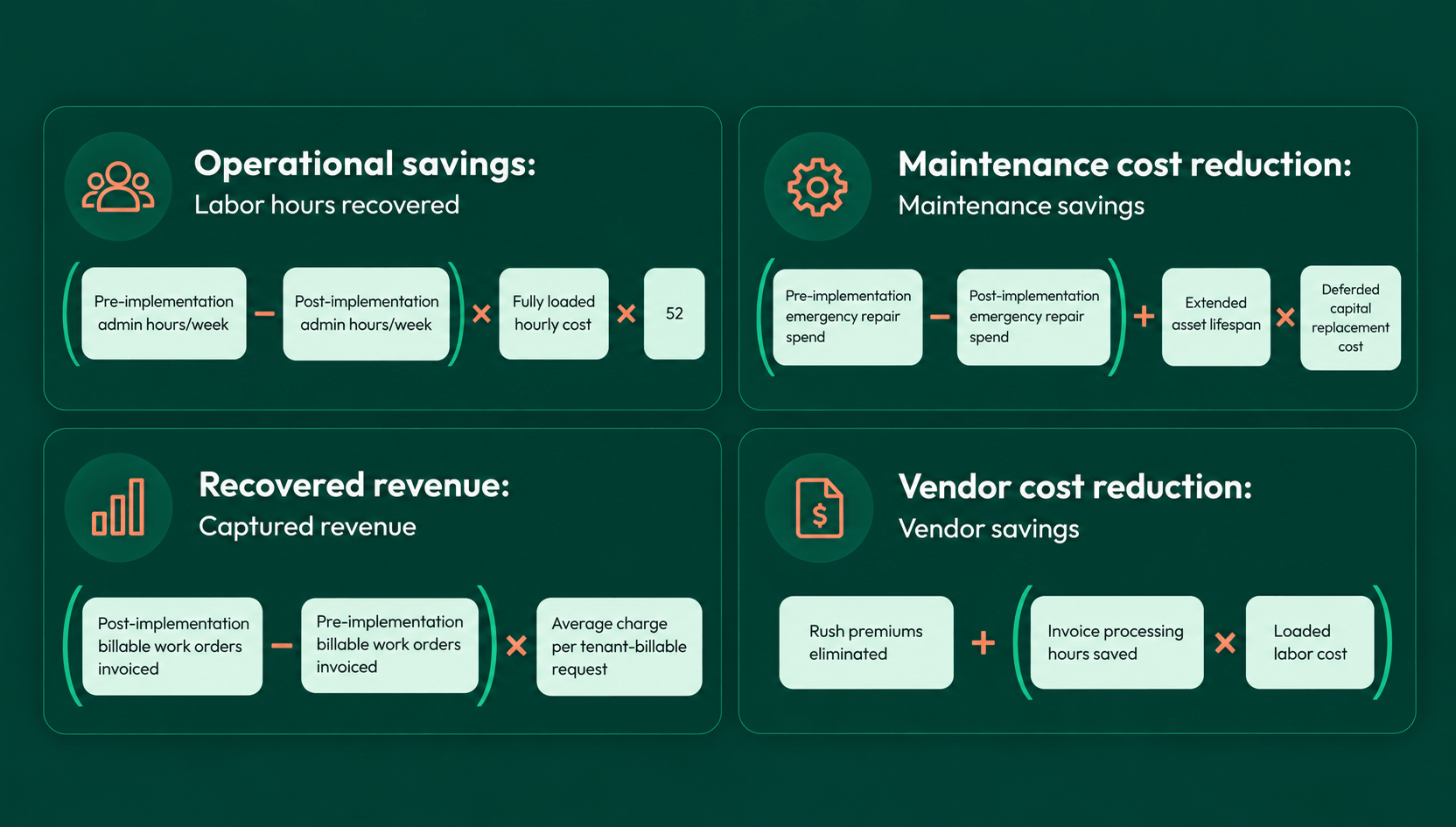
Add all four together to calculate your total annual value gained from your CRE property management integrations:
ROI (%) = (Total annual value gained − Annual software cost) / Annual software cost × 100
A positive ROI in the first 12 months is common for portfolios that were using fragmented commercial real estate software before implementation. For firms already running a CRE property management system, the ROI timeline typically extends to 18 months, as the gains are incremental.
Every dollar saved in operating expenses or recovered in unbilled revenue increases Net Operating Income (NOI). When capitalized at market rates, even modest annual savings create significant asset value.
NOI impact:
NOI increase = Annual operational savings + Annual recovered revenue
Asset value impact:
Asset value increase = NOI increase / Cap rate
For example, a $40,000 annual NOI increase at a 6.5% cap rate adds over $615,000 in portfolio value, far exceeding the annual cost of most building operations platforms, though the composition of that $40,000 varies by property type:
Structure the business case the same way your committee evaluates other capital or operating expenditures:
Proving ROI starts with having the operational data to measure it. Visitt captures that data across every function that drives cost and revenue in a commercial real estate portfolio:
Portfolio-wide reporting ties all of it together, so every metric in this guide, from your baseline to your post-implementation ROI, draws from the same operational data your team is already working with.
If you’re ready to measure and prove ROI across your portfolio, talk to our team and explore how we can work together.
CRE property management software is a set of purpose-built tools for managing building operations, maintenance, tenant requests, vendor coordination, and compliance across a commercial portfolio. It replaces manual processes like spreadsheets and email chains with structured workflows that give property teams and leadership real-time visibility.
Start by documenting how your team operates today, including time spent on work orders, vendor coordination, and manual data entry. Then measure the same metrics after implementation. The strongest business cases connect those operational improvements directly to reduced operating expenses and higher NOI.
When your portfolio is growing faster than your team's capacity to manage it. If work orders are taking longer to close, compliance gaps are widening, or your staff is spending more time on admin than on tenant relationships, not investing is costing you more than putting money down.
Visitt tracks every work order, vendor dispatch, tenant request, and compliance action inside one platform. That operational data feeds portfolio-wide reporting, so property teams can measure response times, maintenance costs, and staff capacity without pulling numbers from multiple systems or building reports manually.
Visitt captures work order volume and resolution times, preventive maintenance completion rates, vendor response performance, and tenant request activity across every property. All of it is accessible through portfolio-wide dashboards, so operators can benchmark individual buildings against the rest of their portfolio.


Insights, trends, and practical ideas for smarter commercial real estate operations.

Discover how Visitt transforms operations and tenant
experience, portfolio-wide.