Product Releases
Sep 30, 2026
How CRE Operators Prove ROI From Building Operations Software
Five steps to go from "it feels valuable" to a business case your buying committee approves.
Your CMMS software keeps maintenance running, but the real question is whether it connects operations to tenant experience and financial performance.
Your portfolio is growing, and traditional Computerized Maintenance Management System (CMMS) solutions aren't cutting it anymore. Sure, it helps with asset maintenance management, but the more properties you add to your portfolio, and the smarter those properties become, the more important it is to use software that connects preventive maintenance, compliance, tenant experience, and billing to enable cross-team portfolio visibility in one platform.
The need for unified building operations software has never been clearer. According to JLL, 84% of CRE leaders call managing costs and budget constraints their top challenge, while only 28% use AI to boost operational efficiency and predict maintenance. And PwC found that profitability expectations dropped from 65% to 55% this year, as operating pressure mounts across the industry.
This problem isn't news to us at Visitt. We built commercial real estate property management software that includes everything a CMMS does, with AI and full integration into building operations from day one. But if this is news to you, keep reading.
CRE firms evaluating software solutions are hearing pitches for:
The problem is that many firms have already adopted something. Multiple somethings, actually. Legacy CMMS software to handle equipment maintenance, while a separate platform tracks compliance, and another manages tenant communications.
Let’s say your CRE firm relies on CMMS software to handle maintenance. It’s highly likely your work orders close on time, equipment is serviced, and the maintenance team feels confident they’re ahead of issues. But it’s just as likely that you’re draining your coffers.
The problem: the CMMS tracks tasks but can't tell leadership whether recurring equipment failures signal the need for strategic capex investment or whether the asset should be sold to protect portfolio value.
The patch: your firm pours money into reactive repairs while missing the strategic decisions that would actually improve returns.
The result: leadership only discovers the pattern months after leases potentially expire because tenant communications live separate from maintenance history, and occupancy data sits in an entirely different system.
Understanding the difference between CMMS software and commercial real estate property operations software starts with what each was designed to solve.
A CMMS centralizes maintenance data and processes. Field staff use the CMMS to log inspections and check assignments through mobile apps while managers track the full maintenance picture:
In short, CMMS software was built to answer one question: how do we keep equipment running?
Commercial real estate property management software includes the capabilities of on premise CMMS software, as well as capabilities to manage every operational, financial, and strategic activity required to keep properties functional, profitable, and compliant while maintaining tenant satisfaction:
Namely, property management software was built to answer a broader question than even the best CMMS software solutions could: how do we run buildings that tenants want to stay in while protecting portfolio value?
You don’t need to compare countless CMMS software examples against CRE asset management software solutions to see the benefits of adopting property management software for commercial real estate. The proof is in the strategic, financial, operational, and tenant satisfaction ROI firms experience:
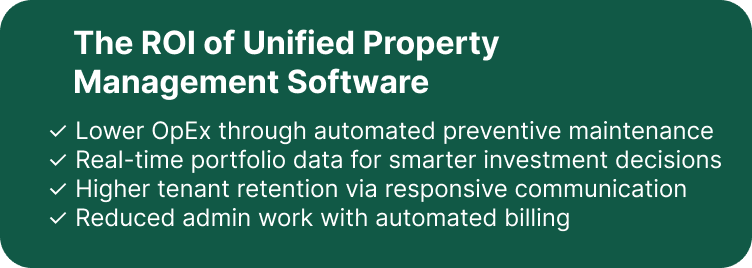
Visitt was built as a single AI-native operations platform where maintenance, compliance, tenant experience, and risk management all run on the same data layer, so every action taken in the building immediately informs the next one.
All of this feeds into dashboards and queryable reporting, where leaders can track trends across properties and take actions that leads to competitive advantages.
If that sounds like what your CRE firm needs, talk to our team and explore how we can work together.
A Computerized Maintenance Management System (CMMS) is software that centralizes maintenance data and processes by logging and tracking work orders, scheduling maintenance, keeping track of assets, and storing and managing inspection and compliance documents. It helps maintenance teams organize repairs and keep records in one place.
CMMS software helps CRE firms manage equipment maintenance across assets. Commercial real estate property management software manages everything required to run buildings, including maintenance, compliance, tenant communication, visitor management, and billing. Property management software does everything a CMMS does, and then connects those work orders to strategic and opertional building data, so teams see the full picture.
CMMS can store vendor certificates and track renewal dates, but it doesn't validate coverage against lease requirements or send automated reminders when certificates expire. Commercial real estate property management software with built-in compliance tools reviews COIs, flags missing coverage, and keeps tenants and vendors on track, reducing liability exposure across portfolios.
Visitt combines all the features of a traditional CMMS system with AI and full integration into building operations. Preventive and predictive maintenance are automated, downtime is reduced, and inspections, service requests, compliance, and tenant experience all connect within one unified platform, giving property teams portfolio-wide visibility from a single dashboard.
Yes. Visitt allows CRE firms to manage office, industrial, retail, data centers, and mixed-use properties from one platform. Technicians can log tasks, photos, and notes on mobile, even offline, with automatic sync later. Multilingual support keeps teams aligned across sites, while AI flags recurring issues, optimizes schedules, and ensures work is completed before it impacts tenants.


Insights, trends, and practical ideas for smarter commercial real estate operations.

Discover how Visitt transforms operations and tenant
experience, portfolio-wide.