Tenant Solutions for Managing Requests and Commercial Real Estate Services
Key takeaways:
- Tenant solutions connect tenants with building systems and stakeholders through platforms that centralize service requests, amenity access, visitor management, and feedback.
- Tenant experience predicts lease renewals, making structured service delivery through tenant management software central to retention and revenue stability across CRE portfolios.
- Visitt delivers tenant solutions in a branded platform where tenant communications flow through the same system property teams use across building operations.
What are tenant solutions?
Tenant solutions are platforms and services that connect commercial real estate (CRE) tenants or occupants with building systems, amenities, and property teams. These solutions provide the operational infrastructure that connects tenant interactions to structured workflows tied to work order management, facility management, and greater commercial real estate property management.
Tenant solutions platforms typically include:
- Service request portals where tenants submit and track maintenance issues
- Amenity management systems that show availability for shared spaces
- Visitor management features, including guest pre-registration, digital access passes, and security integration
- Tenant communication tools for building announcements, emergency notifications, and direct property team contact
- Resource reservation tools that handle scheduling and payment for building amenities
- Feedback mechanisms that capture satisfaction data after service completion
Tenant management software becomes especially critical where multiple tenants share building systems, amenities, and access points. How effectively these solutions operate directly affects tenant experience, felt through response times, amenity availability, and communication clarity.
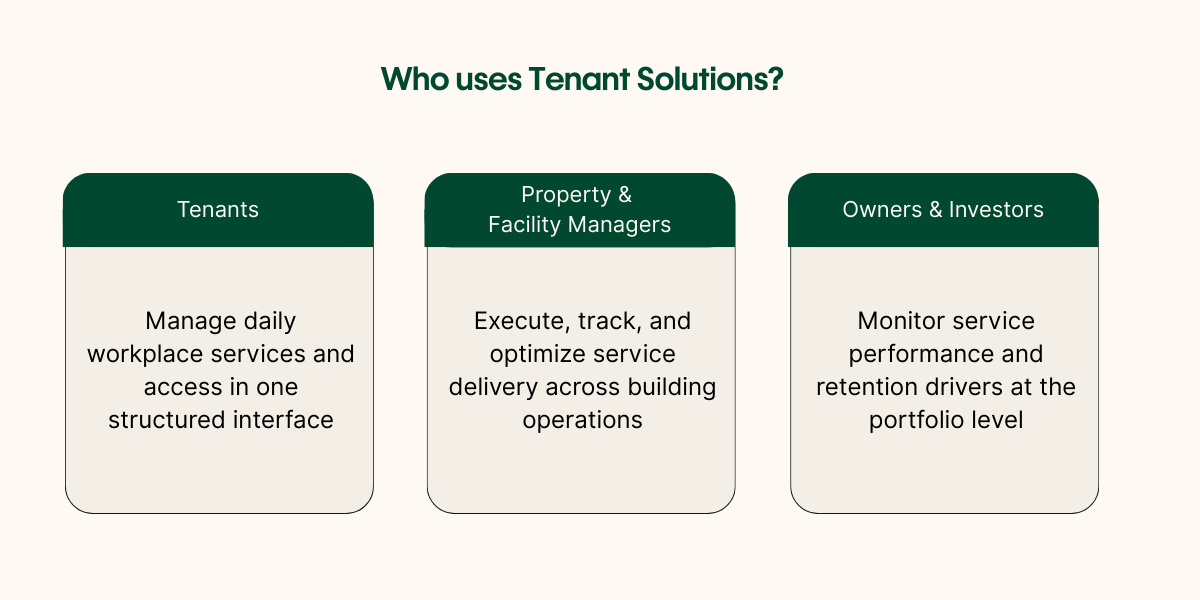
Who uses tenant solutions?
Tenant solutions serve multiple user groups whose interactions create the operational data that property teams rely on for decision-making.
Tenants:
- Submit requests for HVAC, lighting, plumbing, and other equipment maintenance needs without relying on email or phone calls
- Track request status in real time, from submission through assignment and completion
- Book conference rooms and shared amenities when internal space capacity is limited
- Pre-register visitors to streamline secure building entry through integrated visitor management
- Receive notifications about elevator outages, utility work, inspections, or safety updates that affect daily operations
- Access building documents, policies, and compliance requirements in one centralized portal
- View invoices and, where integrated, submit rent or service payments through a secure billing portal
Property and facility managers:
- Manage and prioritize incoming service requests inside structured work order management and CMMS workflows
- Route maintenance tickets to the appropriate technicians based on location, asset type, and workload
- Monitor recurring equipment issues to adjust preventive maintenance schedules
- Track amenity utilization through resource management software to inform commercial tenant improvements planning
- Review visitor logs and incident reporting software records to support risk management and building compliance
- Analyze tenant satisfaction trends and property management KPIs to guide energy efficiency in commercial buildings, upgrades, and retention strategy
Owners and investors
- Use operations dashboards to monitor and report on portfolio-level service performance
- Track tenant satisfaction metrics that influence renewal probability and lease stability
- Identify assets with recurring maintenance costs or service bottlenecks
- Compare amenity use and engagement data across properties to guide capital allocation
- Evaluate the impact of commercial tenant improvements on occupancy and retention
- Use commercial real estate data analytics to align tenant services with net operating income performance
How do tenant solutions work?
Tenant solutions operate as a connected loop between occupant input and building execution.
- Data is captured and structured. A maintenance request, amenity booking, or visitor registration is logged with location, time, asset reference, and priority.
- Execution is triggered. The action is routed to the appropriate team, access controls or schedules are updated, and progress is tracked through completion.
- A continuous record is created. Each step is time-stamped and stored, making it easier to retrieve as needed.
- Decision-making is informed. Aggregated service and usage data are analyzed to guide maintenance planning, space allocation, and capital strategy.
The loop remains continuous: tenant action drives execution, execution produces data, and data shapes future operational decisions.

Why does your CRE firm need tenant management software?
Research from MIT's Center for Real Estate shows that tenant satisfaction is the strongest predictor of lease renewal rates. That finding places daily service delivery at the center of revenue stability. When maintenance requests, visitor access, amenity bookings, and building updates move through tenant management software instead of informal coordination, tenants experience the property as organized, predictable, and aligned with their operational priorities.
NAIOP's Commercial Real Estate Development Association also reports that each avoided vacancy delivers meaningful financial savings once downtime, brokerage fees, concessions, and improvement costs are factored in. Software centralizing tenant services gives CRE firms a consistent way to monitor the operational signals that influence those outcomes. Instead of identifying renewal risk after a lease decision is made, property teams can see early indicators in response patterns, access data, and amenity demand.
For CRE portfolios, this connection translates into measurable advantages:
What are some of the best practices for using tenant solutions in CRE?
Tenant solutions improve retention and service reliability when they are governed by clear rules. When configured correctly inside AI property management software, the system should ensure tenants feel seen, heard, and valued.
Set defined targets
General inquiries should receive acknowledgment within 24 hours. Service-impacting issues such as HVAC failure, water intrusion, or access disruption should trigger immediate alerts and escalation to on-site teams. These expectations must be visible to both tenants and staff so performance can be measured against property management KPIs and risk management thresholds.
Best practices include:
- Configuring automated acknowledgments with estimated response windows
- Assigning priority levels tied to defined maximum resolution times
- Reviewing weekly response-time reports and flagging tickets exceeding SLA targets
Require digital submission and centralized records
Maintenance requests, policy updates, lease notices, and access changes should move through the tenant platform rather than email threads. Every interaction should be time-stamped and attached to the correct unit, lease, and asset record inside your document management system, strengthening the firm's defensibility during audits or insurance reviews.
Best practices include:
- Blocking service intake through personal email to avoid off-system requests
- Attaching photos, technician notes, and inspection findings from commercial property inspections to each ticket
- Linking tickets to specific equipment within the asset tagging system
Keep tenants updated
Delays are often unavoidable. Silence is not. If a part is on order, the tenant should see the expected delivery date. If a contractor visit is pushed, the new timeline should appear immediately in the request status.
Best practices include:
- Setting automatic follow-ups every 48 hours for open tickets
- Requiring completion summaries before ticket closure
- Triggering satisfaction surveys within 12 hours of resolution
Segment and personalize building communication
Broadcast messaging should be segmented and operationally linked so updates are delivered with precision through the tenant app. When announcements about access changes, inspections, or utility shutdowns are aligned with lease terms, occupancy schedules, and building zones, tenants receive only what affects them. This reduces message fatigue and increases the likelihood that critical updates are read and acted on.
Best practices include:
- Schedule announcements in advance for planned maintenance and automatically release reminders 24 hours and 1 hour before impact
- Configure conditional messaging so only affected floors, suites, or access groups receive the alert
- Track open rates and acknowledgement confirmations for safety-related notices
- Link each announcement to the relevant work order or incident record for audit traceability
What do tenant solutions look like with Visitt?
Visitt delivers tenant solutions inside one centralized CRE property management platform, where tenant communications operate through the same structured system that property teams use across building operations. Tenants interact with their building through a branded mobile or web tenant app that handles:
- Service request submission and tracking with real-time updates and direct chat with property teams
- Guest pre-registration with QR passes and watchlist integration that feeds visitor management and visitor access workflows
- Amenity browsing, booking, and payment with live availability that syncs with resource reservation systems, revealing usage patterns and informing capital planning
- Branded alerts, broadcast messages, and instant notifications on work orders, deliveries, and building updates
Every action links directly to the work order management system that tracks equipment maintenance and facility management, with Visitt's AI handling request categorization and routing issues to the right teams based on building location, request type, and current workload. This, while Live Translate enables multilingual messaging through tenant communication tools, and built-in surveys capture post-service feedback, improving response times and resolution quality, while promoting a more positive tenant experience and lease renewals.
See what Visitt's tenant solutions can do for your portfolio.