What is Visitor Management? A CRE Guide to Building Access and Oversight
Key takeaways:
Visitor management is the way CRE teams record, screen, and track visitors so they always know who is on-site, when they arrived, and why they are there.
Across CRE portfolios, visitor management systems help firms manage access, reduce security and compliance risk, and keep visitor activity organized, as volume and building complexity grow.
Visitt supports visitor management by connecting visitor access, watchlists, and live presence data directly to tenant workflows and building operations across properties.
What is visitor management?
Visitor management is the process of recording, monitoring, and managing anyone who enters a property and is not a tenant or an employee. It begins when a visitor is expected or arrives on-site and ends when they sign out and leave, creating a clear record of who was present, when, and for what purpose. At its core, visitor management exists to protect people and property while keeping the experience of entering and moving through a building smooth.
When it comes to commercial real estate (CRE) property management, visitor management takes on added complexity:
- Office buildings host meetings, interviews, and recurring guests.
- Industrial and logistics sites manage vendors, contractors, drivers, and controlled zones.
- Retail and mixed-use properties see high visitor volume alongside service access.
What is a visitor management system?
Across these environments, building visitor management systems (VMS) replace ad-hoc front desk handling with a consistent process that links visitors to the right tenants, spaces, and building operations. A visitor management system is the PropTech that provides the digital layer behind that process, automating check-in and check-out, recording visitor activity, and connecting arrival data to security and compliance workflows, enriching commercial real estate data analytics capabilities.
Common security visitor management system features
Most visitor management tools are built around the same core capabilities:
- Digital check-in and check-out
- Pre-registration for expected visitors
- Host notifications and real-time alerts
- Visitor ID verification and badge printing
- Access control integration
- Document and NDA signing during check-in
- Watchlists and denied-party screening
- Centralized visitor logs and analytics
- Mobile or kiosk-based visitor management app options
These features form the foundation of an automated visitor management system, using AI in commercial real estate to screen against watchlists, recognize name variants, and flag unusual patterns. This keeps visitor records accurate without constant manual review, making visitor management part of how smart buildings maintain access control and risk oversight at scale.
Types of visitor management solutions
Visitor management solutions generally fall into a few common types, shaped by how much control, visibility, and scale a property team needs.
How to choose a visitor management system for office buildings
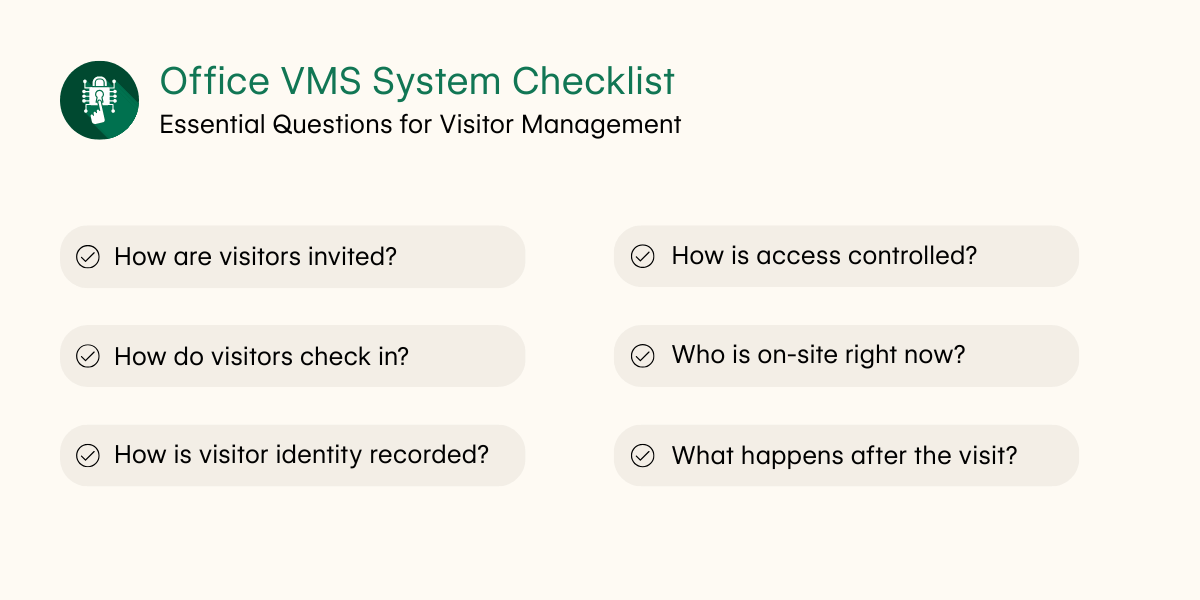
Office buildings handle a steady mix of meetings, interviews, vendors, and recurring guests, often moving through the same entry points at the same time, which makes the visitor journey through the building the right place to start when evaluating a visitor management system.
- Check how visitors are invited or pre-registered: A visitor management system for office use should support calendar-based invites or tenant coordination so arrivals are expected rather than handled ad hoc.
- Evaluate how arrivals are handled at peak times: The system should support automated check-in that records arrivals without requiring front desk intervention.
- Confirm how visitor identity and visit context are captured: Visitor management software should store identity details, visit purpose, and host information in a single visitor record tied to the correct tenant and space.
- Review how access rules are applied during the visit: A security visitor management system should apply badges, access control, or restricted areas based on visitor type.
- Understand how live visitor data is used during the visit: The system should make visitor presence visible to support host awareness, security oversight, and incident response while the visit is in progress.
- Assess how visitor records are stored after departure: A cloud-based visitor management solution should centralize visit data to support audits, reporting, and long-term risk management across office properties.
Why does your CRE firm need a visitor management system?
Visitor management systems turn CRE property visitor flow into a controlled, auditable process that supports safety, compliance, and accountability across buildings. Research shows 74% of UK workplace security breaches result from inadequate visitor screening, and incidents have shown how easily unauthorized individuals can gain access by posing as contractors or service providers, increasingly tying the benefits of a visitor management system to risk exposure and brand protection.
Thus, the advantages of a visitor management system are clear:
- Stronger security and access control
- Lower operational and reputational risk
- Faster, more consistent check-ins
- Better compliance readiness
- Improved tenant experience
How do CRE firms use building visitor management systems?
CRE firms are using visitor management systems to give property teams clearer oversight of who is on-site while reducing the time spent managing visits across major use cases.
Managing peak hours while keeping a reliable visitor record
Peak arrival times expose the limits of paper logs and manual front desk handling because staff can only process one visitor at a time while traffic continues to build. A visitor management solution combines automated check-in with a cloud-based visitor log that's time-stamped and linked to the tenant and visit type, allowing visitors to sign themselves in while each arrival is recorded in real time.
Bringing structure to deliveries and service visits
Deliveries and service calls often create confusion in shared commercial buildings because reception staff have to identify and reach the right recipient in the moment, leaving the delivery in limbo until someone responds. With a visitor management system, the delivery person checks in digitally and selects the intended recipient as part of that check-in. The system can then send an automated delivery notification to the right person, which is routed through the check-in workflow itself, removing the receptionist as the manual "router" and creating a time-stamped record of when the driver arrived and when the recipient was notified.
Controlling access based on identity and purpose
Not every visitor should access every area of a commercial property. Automated visitor management systems verify identity during check-in and issue access credentials that reflect the visit's purpose, such as meetings, preventive maintenance, facility management, office maintenance, or deliveries. Because access events are recorded as part of the visitor record, CRE teams can later review movement as part of building compliance software and security visitor management system requirements.
Capturing agreements and consent at entry
Many CRE environments require visitors to acknowledge NDAs, safety rules, or data handling policies. Presenting these agreements during check-in places compliance directly into the visitor management process, before access is granted. Signed documents are stored digitally alongside the visitor record, rather than separately across systems.
Maintaining live visibility for hosts, security, and emergencies
When an emergency unfolds, property managers need to know who is still inside, and where were they when it began. In an evacuation or lockdown, property and security teams rely on visitor data to see which visitors were on-site, which tenant they were connected to, and where their last recorded access occurred, so they can confirm safe exit or focus response efforts on specific areas. Afterward, those same records help determine who was present in a given location at the time of the incident, which can be critical when reviewing responsibility or sequence of events during commercial property inspections.
Why do CRE teams choose Visitt for their visitor management?
Visitt brings visitor management into the same system used for secure day-to-day property operations. Tenants send visitor invitations directly through the platform, credentials are shared before arrival, and check-in follows one consistent flow across buildings. This shortens check-in times during busy periods and reduces pressure on lobbies and front desks. Tenants and property teams can see visitor status as it changes, without relying on separate logs or manual updates.
With Visitt, access control and security stay connected to the visitor workflow. Credentials automatically expire after use, and every access event is recorded inside Visitt for review and audit needs; the platform integrates with third-party access control systems while keeping all visitor data centralized. And the Visitor Watchlist adds proactive screening by allowing tenants to flag unwanted visitors using names, AI-supported variants, photos, and action instructions. When a visitor is expected, the system checks for matches and alerts the relevant teams. This helps portfolio owners decide whether tenant primary contacts can manage their own watchlists, keeping oversight clear across buildings.
See how Visitt's AI tools for visitor management support your CRE portfolio.