Product Releases
Aug 31, 2026
Visitt’s Work Order Request Process: Built for Property Teams Managing at Scale
Work order requests don't stop coming in; the property teams that handle them well have a process that scales with their portfolio.
The rooftop unit practices that keep tenants comfortable and capital plans on schedule.
Commercial tenants renew their leases where they're satisfied, with CBRE's 2024 Americas Office Occupier Sentiment Survey placing renewal preference at 80% of occupiers and 92% of large occupiers re-upping when the space fits their needs. That reality is exactly what we hear in the conversations Visitt has with the people responsible for keeping buildings comfortable: on-site technicians, property managers, engineers, and owners like you.
That said, too many property teams have yet to trace that satisfaction back to the RTU HVAC systems on their buildings’ roofs.
The unit on the roof sets the temperature on every floor beneath it and drives a meaningful share of the utility bill, with HVAC accounting for 44% of energy used on-site in commercial buildings, according to the U.S. Department of Energy. It weighs on the capital side too: a rooftop unit replaced before its time is a CapEx project that competes directly with tenant improvement budgets, and the overhead of running inefficient equipment flows into the rent tenants pay and the ROI investors measure. Few single pieces of equipment carry that much weight in how a building feels, what it costs to run, and what it returns.
The strongest teams stop treating the commercial RTU as "out of sight, out of mind" and instead run it with intention, making sure comfort and asset life don't get left behind as portfolios grow.
The RTU HVAC definition and best practices below reflect what Visitt is seeing across assets and portfolios.
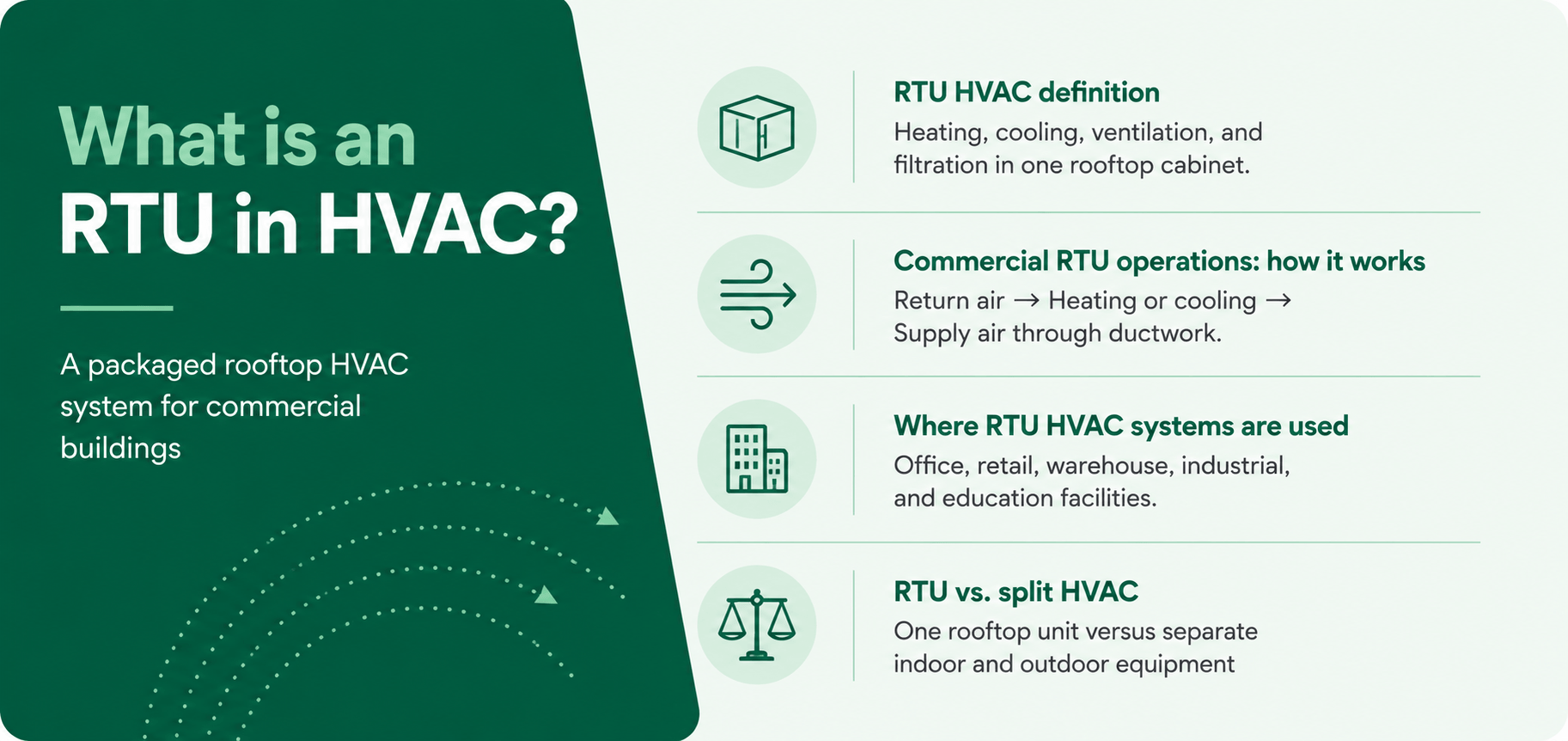
RTU HVAC meaning: an RTU, or rooftop unit, is a self-contained HVAC system that combines heating, cooling, ventilation, and air filtration in one weather-resistant cabinet installed on a building's roof. Common across office buildings, retail centers, warehouses, and other commercial properties, an RTU HVAC system connects directly to the building's ductwork to deliver conditioned air throughout the space while keeping equipment accessible for service and maintenance, and away from everyday tenant activities.
Think installing an RTU HVAC system means lugging the hardware to your roof, connecting some wires, and stepping back? Think again. From the moment you decide to order RTUs and through their lifespans, there are best practices you can adopt to make the most of your investment.
If your units are aging and the capital budget is the binding constraint, start by choosing the right RTU for each building. If the equipment is sound but tenant comfort is where you're losing ground, tenant experience should be your focus. And if the crew is stretched thin, proactive maintenance and inspection practices will return the most.
Comfortable tenants are satisfied tenants, and satisfied tenants renew. The temperature at a tenant's desk and the air in their meeting rooms come straight from the rooftop unit above them, which makes RTU performance a direct input to the satisfaction that decides whether a lease gets signed again. Thus, treating that performance as part of the tenant experience belongs in every proactive property management strategy.
To work through it, we recommend approaching the task as true investigators do, using the 5 Ws (and how).
Comfort is the part of tenant experience the RTU box controls outright, which makes its performance a retention lever rather than a maintenance afterthought. Steady temperature and clean air keep hot and cold calls off the service log, and a building that holds comfort through summer peaks and winter lows gives a tenant one less reason to shop the market at renewal.
The opposite is just as true: a rooftop unit that swings the temperature or dries out on humidity control generates repeat complaints, and each unresolved complaint chips at the satisfaction that CBRE ties directly to renewal preference.
Track the measures that decide how a space feels:
Adopt a centralized approach to RTU HVAC activity to give tenants the consistent experience they crave. Preventive maintenance schedules on each rooftop unit keep small faults from reaching the floor, while offering a tenant app gives occupants a way to communicate their comfort needs in real time, instead of at renewal. Integrating those reports with the rest of the building’s operations, from work orders to amenities management, keeps every response efficient and every step accountable.
Get ahead of the seasons. Comfort complaints spike when an RTU meets its first real cooling load in summer or its first heating demand in the cold, so the time to confirm a unit is holding temperature is before the season turns. Tenant renewal windows are the other clock worth watching, since a stretch of unresolved comfort issues in the months before a renewal conversation works against the team at exactly the wrong moment.
Choosing a commercial RTU well means matching the unit to the building on more than one front, and the teams that treat the purchase as a considered decision rather than a like-for-like reorder get steadier comfort at lower operating costs, for years to come.
The same 5 Ws (and how) can be applied here as well.
Choosing deliberately pays back on every front the specification touches. A right-sized commercial RTU holds indoor humidity in the 40 to 50% range and runs steady 15 to 20 minute cycles instead of short-cycling toward early failure, and a high-efficiency model cuts 20 to 40% off the energy an aging unit was drawing. Aligning on the right size for each building’s needs is what carries a unit to its full 15 to 20 year service life and keeps capital free for the tenant improvements that support renewals.
Weigh four specifications to narrow your search:
Match the specification to the building's climate and roof before you order. A rooftop AC unit in a hot, humid market carries a heavier dehumidification load than the same unit in a dry one, which changes both tonnage and airflow. Confirm curb dimensions, roof access, and structural capacity up front, since a mismatched curb adds cost and a heavier high-efficiency unit can trigger a structural review before it lands.
Decide before the current unit fails, and recalculate the load at every replacement rather than reordering the same tonnage. This will help account for potential shifts caused by a lighting retrofit, occupancy change, or envelope upgrade. Reading the CapEx forecast against unit age can indicate which buildings to plan for this year and which can wait.
Rooftop units run in one of the harshest spots in the building, taking year-round sun, wind, rain, and debris that indoor equipment never sees. A preventive maintenance schedule built around each unit's location, usage, and weather exposure will help your team maximize the unit’s value.
The same 5 Ws (and how) lay the schedule out.
A commercial RTU on a disciplined schedule runs its rated 15 to 20 years, while the same unit under reactive-only service fails economically at 8 to 12. And since emergency repairs run 3 to 5 times the price of scheduled work once after-hours labor and rushed parts get counted, you quite literally can’t afford to remain reactive when it comes to these systems.
RTU service breaks into tasks that each match a component's wear rate:
Preventive maintenance happens on the roof, on the unit and everything around it. Inside the cabinet, a technician services the internal components, the coils, and the electrical connections. Around it, the work reaches the drainage pan, the condensate line, and the curb seal that keeps weather out. Clear access matters too, since a path free of debris is what lets the service happen safely.
Inspection readiness is a state a building holds year-round. A rooftop unit serviced on schedule and documented as the work happens is already ready when an auditor or insurer asks.
The same 5 Ws (and how) keep a portfolio audit-ready.
The AIM Act Part III lowered the EPA refrigerant recordkeeping threshold from 50 pounds to 15, which pulls most rooftop units into full Section 608 scope for the first time. Violations run up to $124,426 per day, and records have to be available on demand rather than reconstructed after the request. Additionally, gas-fired units add a life-safety layer, since a cracked heat exchanger lets carbon monoxide into the supply air, which makes the fall heat exchanger inspection a check no team defers.
Documentation is what turns completed work into proof, so a compliant record on each rooftop unit carries the pieces an inspection asks for:
Here too, a centralized approach is key. When document management is integrated with the rest of your building operations workflows, records become and remain accurate and current. That gives a property manager the full compliance history on demand and a regional manager visibility across the portfolio.
Always! An audit or inspection can come without warning. A demand for records leaves no time to reconstruct them, while a portfolio kept ready year-round meets an inspection on any day it comes.
The strongest RTU HVAC strategies become part of daily building operations, giving every team the same view of the asset and the decisions about it that need to be made.
With Visitt, CRE firms can support RTU HVAC operations through:
Talk to our team and explore how we can work together.
An RTU, or rooftop unit, is a packaged HVAC system that heats and cools a commercial building from a single cabinet on the roof. Every major component sits inside one weather-resistant housing, which connects to the building's ductwork and conditions each zone below without taking up interior space.
An RTU AC unit keeps every component in one rooftop package, while a split system separates the indoor and outdoor equipment. RTUs suit commercial buildings because technicians can service everything in one spot on the roof. Split systems fit residential properties and smaller offices better.
Tenants judge a building on how it feels the moment they walk in, and rooftop units control that experience. Steady temperatures keep comfort complaints off the service log, and a building that stays comfortable year-round gives tenants one more reason to renew.
Platforms like Visitt turn RTU upkeep into scheduled workflows that work together with all your building operations and can be seen and dealt with from the same operations dashboard. Preventive maintenance tasks trigger automatically, and technicians log completed work right from the roof.
The strongest teams pull maintenance history and inspection data into one platform so patterns surface early. Visitt gives portfolio-level visibility into which units generate repeat repairs and where the next capital investment belongs, so decisions rest on live operational data rather than assumptions.


Insights, trends, and practical ideas for smarter commercial real estate operations.