
Product Releases
Sep 30, 2026
How CRE Operators Prove ROI From Building Operations Software
Five steps to go from "it feels valuable" to a business case your buying committee approves.
Tips and tricks to keep your property management budget and your team's daily work in sync.
CRE firms have spent this year proving their budgets can weather almost anything, from rate swings to vendor costs that moved mid-contract. Contingency reserves absorb some of the variability, but no reserve replaces a property management budget built to see surprises coming, and most planning processes still can't. According to the 2025 FP&A Trends Survey, only 2% of organizations consider their planning teams optimized, with over 60% held back by manual processes and inconsistent data.
While we can't promise a year without surprises–nobody can–we can offer you and your team insights into property management budget planning that shrinks how many surprises reach the budget, and how hard they hit when they do.
So what does that look like in practice?
The tips below reflect what Visitt sees across teams that treat property management budgeting as a year-round practice instead of a fourth-quarter scramble.
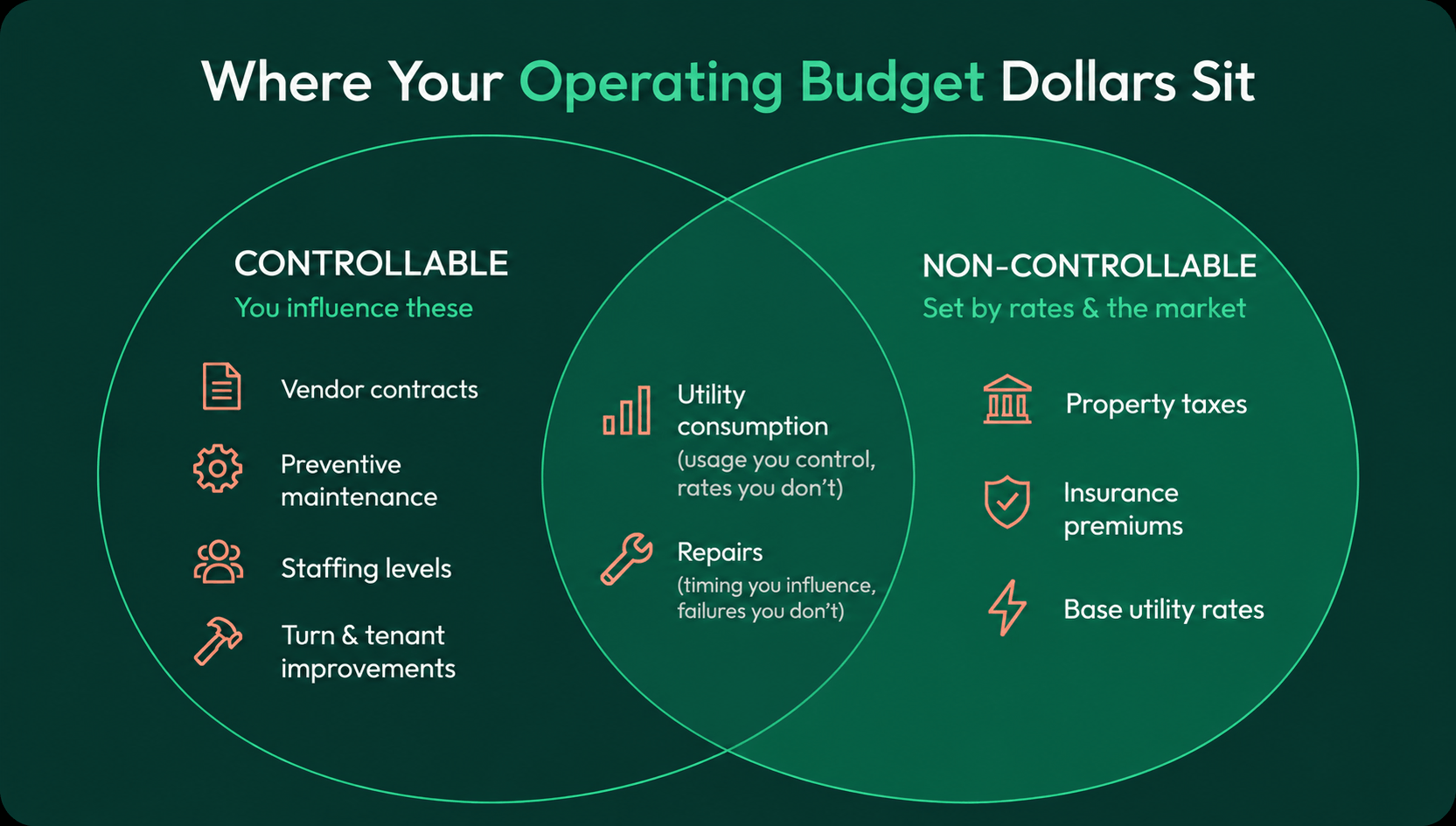
A property management operating budget covers the recurring income and expenses of running a property across a fiscal year, separate from the capital budget that funds long-term improvements and major asset replacements. Its expenses break into controllable costs the team can influence through vendor negotiation or scheduling, and non-controllable costs like property taxes, insurance premiums, and utilities that rise and fall with rates and consumption.
Most of the expense side falls into fixed costs:
Variable costs are where property management budgets are hardest to pin down, since these costs move with usage and the condition of the assets themselves:
We've worked with CRE teams managing every kind of portfolio, and the ones whose budgets need the fewest mid-year corrections share a handful of habits. These are the property management budget planning practices worth adopting to get more out of both the process and the numbers it produces.
Property management budget planning is as much about accountability as it is about the numbers, and accountability comes down to the ‘who’ and the ‘when’:
How better to plan your property management budget than on data from the buildings you're planning to fund? The operational history tells you where estimates ran short and which assets are due to fail:
Budget surprises come from the delay between when money gets committed and when finance finds out. When approvals and operations sit siloed, a committed cost only reaches the budget at month-end reconciliation, weeks after the work was authorized and often too late to correct:
Reactive repairs are the least predictable and most expensive line in a property management budget, and preventive maintenance is what turns that spend into a scheduled cost you can plan around.
A property management budget set in Q4 and left alone stops matching the portfolio within a quarter, as the assumptions you locked in fall out of date. Benchmarking gives the numbers outside context, and a fixed review cadence keeps them current:
Every accurate property management budget rests on operational data teams can trust. Visitt brings work order management, maintenance, labor, and vendor spend into one platform, so the numbers behind next year's budget come from how your buildings run.
With property management budget planning running on a continuous, centralized data loop, teams gain:
There’s no time to plan your property management budget like the present. Talk to our team and explore how we can work together.
A property management budget is the financial plan property teams use to track projected income against operating expenses for a building or portfolio, typically built annually. It separates fixed costs like labor and contracts from variable costs like maintenance and utilities, giving teams a baseline for variance analysis once the year is underway.
Most CRE teams reserve 5-10% of total operating costs for unplanned repairs or scope changes that weren't part of the original plan. That reserve sits separate from the base operating budget so one unexpected HVAC failure doesn't force a re-forecast of the whole year.
Occupancy changes shift utility use and amenity demand across a building. A property management operating budget built without checking in with tenants on space use risks over-budgeting for services nobody needs, or under-budgeting for HVAC and cleaning costs tied to how much square footage is actually occupied.
A pattern of repeat work orders on the same unit or system is usually a better predictor than its warranty date. Teams that pull that history into property management budget planning catch aging HVAC or roofing before it becomes an emergency capital expense.
Visitt keeps work order costs and vendor activity inside the same platform where budgets get built, so property managers can compare planned line items against spend as work happens instead of waiting for a monthly report to catch a variance.


Insights, trends, and practical ideas for smarter commercial real estate operations.

Discover how Visitt transforms operations and tenant
experience, portfolio-wide.