The 9 Property Types of Commercial Real Estate and What Each One Demands from Your Operations Team
(Plus bonus emerging CRE property types)
By
Team Visitt
Released
Aug 7, 2026
Last update
Oct 3, 2026
CRE Insights
TL;DR
The nine types of commercial real estate differ as much in how they are operated as in how they generate returns, and understanding those differences is where a sound investment strategy begins
Each commercial property type carries its own lease structure, tenant profile, and operational requirements, from healthcare's regulatory demands to industrial's logistics focus to retail's location dependency
Visitt supports building operations across every commercial real estate asset class, region, and language, so the same operational standards apply whether your portfolio spans one property type or all nine
Commercial real estate is one of the most diverse asset classes available to investors and operators alike. Global real estate volumes rose 14 percent year-on-year to $888.6 billion in 2025, reflecting returning appetite across every major commercial property type and market, according to MSCI data cited in the PwC and Urban Land Institute's Emerging Trends in Real Estate Global Outlook 2026.
Senior industry leaders increasingly point to diversification across countries and sectors as one of the most important portfolio principles of the current cycle, arguing that for the first time in two decades, it has become a central driver of returns rather than a secondary consideration. That logic applies at every level of the market, from institutional allocators managing global portfolios to operators building exposure across commercial real estate categories for the first time.
Understanding what each commercial real estate property type offers, and what it demands, is where a sound investment and operational strategy begins.
The Visitt team supports centralized building operations and facility management across every major asset class, region, and language, so your operational standards scale as consistently as your portfolio does.
Commercial real estate investing starts with knowing your asset classes
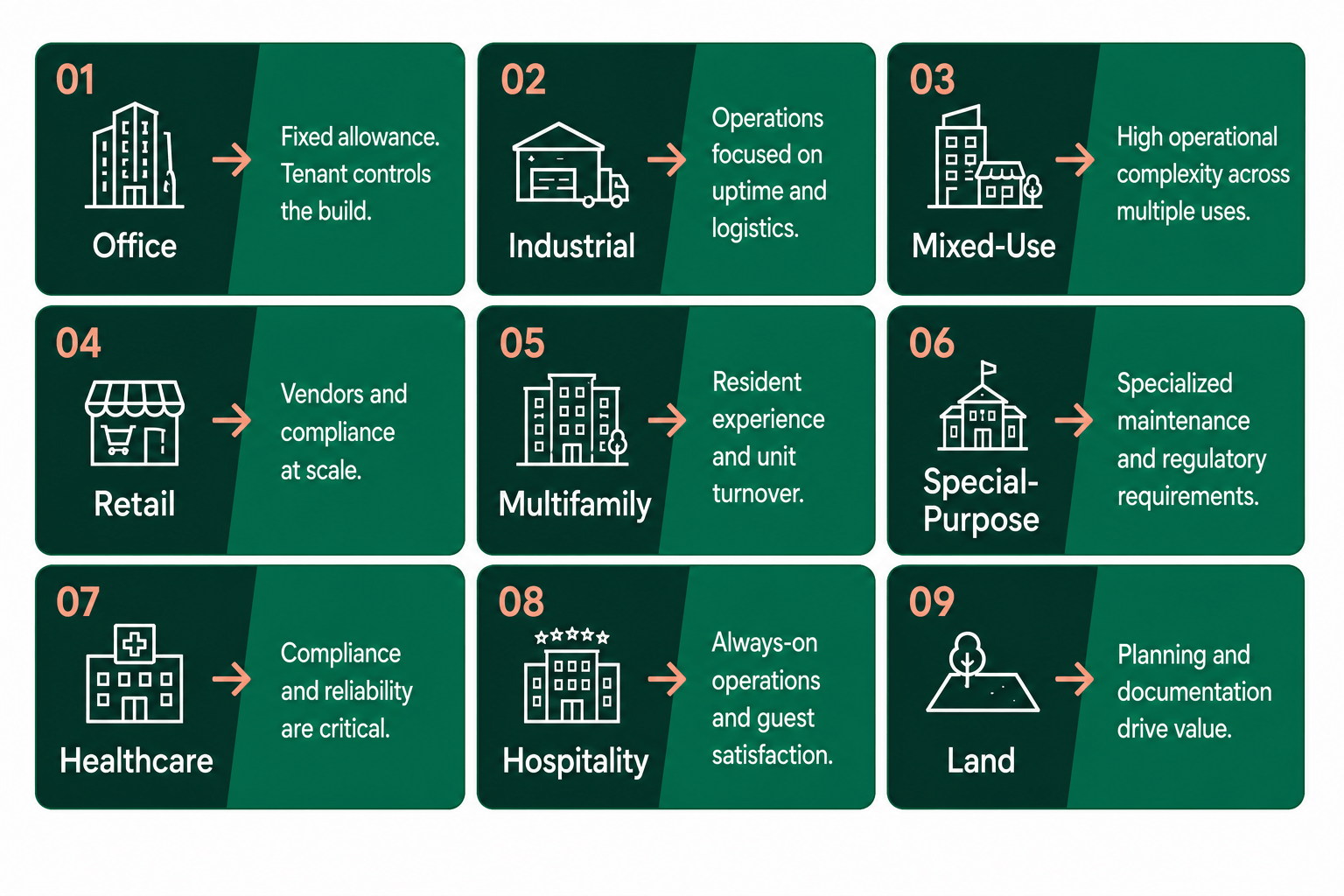
Commercial real estate property types differ as much in how they are operated as in how they generate returns.
Commercial property type
Primary use
Healthcare
Medical care and clinical services
Hospitality
Guest accommodations and travel services
Industrial
Warehousing, logistics, and manufacturing
Land
Raw or undeveloped land held for future use
Mixed-use
Integrated residential, retail, and office use
Multifamily
Residential housing at scale
Office
Corporate and professional workspaces
Retail
Consumer-facing retail and dining
Special-purpose
Single-use facilities with specialized requirements
The nine commercial real estate property types and their primary uses.
#1 - Office
Office buildings are among the most recognizable assets within the commercial properties definition, ranging from single-story suburban properties to multi-story urban towers:
Class A: The highest-quality office buildings in a given market, with premium locations, above-market rents, and state-of-the-art systems attracting premier tenants
Class B: Competitive buildings priced at average market rents that may lack the location or finish level of Class A but offer solid fundamentals and value-add potential
Class C: Functional commercial space at below-market rents in less desirable locations or with older building systems, typically requiring capital investment to remain competitive
What office buildings demand from your operations team
Smart building infrastructure that supports AI in building systems for energy optimization, building access control, and real-time operational visibility
Resource management software that handles space allocation and amenity scheduling across multiple tenants without manual coordination
Vendor SLA compliance tracking that protects tenant experience and gives operations teams a defensible record of service delivery
Why invest in office?
Counter-cyclical repricing creating attractive entry points in select markets
Flight-to-quality demand concentrating occupancy in well-located Class A commercial buildings, while secondary assets face structural headwinds
Longer lease terms relative to most other commercial property types
#2 - Industrial
Industrial properties are real estate commercial buildings located along major transportation corridors, valued for clear heights, loading capacity, and power infrastructure rather than tenant-facing amenities. Industrial property management focuses on operational throughput and logistics continuity, with demands that vary significantly by category:
Heavy manufacturing facilities, built around specific machinery that are difficult to repurpose
Light assembly spaces, used for product assembly, storage, and shipping
Distribution warehouses, positioned along supply chains for high-volume outbound shipping
General-purpose warehouses, focused on storage, including cold storage variants
Truck terminals, devoted entirely to transferring goods between vehicles
R&D facilities, configured around tenant-specific research and development needs
Showrooms, combining warehouse, office, and product display space
What industrial properties demand from your operations team
Urban location premiums in markets where walkability and live-work-play density drive tenant and resident demand
#4 - Retail
Retail properties house consumer-facing businesses, and the health of any retail commercial property is closely tied to its tenant mix, trade area demographics, and location quality rather than the building itself:
Strip malls and shopping centers
Larger community retail centers
Power centers anchored by major national retailers, typically located near interstate highways
Regional malls spanning 400,000 to 2,000,000 square feet with multiple department store anchors
What retail properties demand from your operations team
Vendor insurance compliance validation for every contractor on site, where the volume of third-party activity creates consistent certificate of insurance exposure
Tenant insurance requirement tracking that ensures every lease is covered to the correct standard without manual follow-up consuming team capacity
Why invest in retail?
Significant repricing over the past decade has reset entry valuations across retail formats, creating attractive risk-adjusted returns for investors willing to underwrite the sector carefully
Supply constraints supporting rental growth, with very little new retail development coming to market across most regions
Grocery-anchored and service-based tenant demand that has proven resilient across economic cycles, rewarding investors in the right formats and locations
#5 - Multifamily
Multifamily properties are residential commercial buildings with five or more units under single ownership. Any residential building meeting that threshold qualifies as commercial real estate for financing and valuation purposes, with income generated through residential leases.
Class A: Newer, well-located properties with premium finishes, modern amenities, and above-market rents targeting high-income renters
Class B: Mid-tier properties in competitive locations that offer quality space at average market rents, often presenting value-add opportunities
Class C: Older properties in less desirable locations offering below-market rents, typically requiring capital investment to remain competitive
What multifamily properties demand from your operations team
Tenant portal access that gives residents a direct, responsive channel for maintenance requests and communications
Preventive maintenance software that keeps recurring inspection and servicing schedules on track across units and common areas
Incident reporting software that ensures safety events are documented and resolved consistently, protecting both residents and the asset's compliance standing
Why invest in multifamily?
Structural housing demand that persists across economic cycles because residential occupancy is a fundamental need rather than a discretionary business decision
Rent escalation potential that compounds over time, as short lease cycles allow operators to reprice units to market far more frequently than long-term commercial leases
Supply constraints in most established markets, supporting rental growth
#6 - Special-purpose
Special-purpose commercial properties are designed for a single specific use that cannot easily be converted without significant capital investment. These commercial real estate classifications are more difficult to value than other property types because comparable sales are limited and the income model is entirely specific to the occupant. Examples include:
Houses of worship
Schools
Theaters
Stadiums
Parking structures
Car washes
What special-purpose properties demand from your operations team
Asset-specific maintenance schedules built in a CMMS platform that reflects the property’s systems and infrastructure demands
Compliance documentation tailored to the specific use’s regulatory requirements
Vendor management protocols that account for the specialized contractors these assets require, where general facility vendors may lack the necessary expertise
Why invest in special-purpose properties?
Long lease terms driven by high tenant improvement costs, creating income stability
Limited comparable supply in most markets, supporting asset values for well-located special-purpose commercial buildings with established use demand
Lower investor competition in many subtypes, where the knowledge barrier to underwriting creates pricing advantages for specialists
#7 - Healthcare
Healthcare facilities are among the most specialized commercial property types in any market. Tenants invest heavily in buildouts that standard commercial space cannot support without significant capital expenditure, which drives longer lease terms and lower turnover than most other commercial real estate categories.
Within this commercial property type, subtypes include:
Medical office buildings serving physician groups and outpatient care providers
Hospitals and acute care facilities with complex infrastructure requirements
Senior housing and assisted living communities serving the 80-plus population cohort
Diagnostic and specialty care centers with equipment-specific space requirements
What healthcare facilities demand from your operations team
Building compliance software to manage certifications, inspection records, and regulatory documentation across every space type
Structured preventive maintenance schedules for critical building systems where lapses carry direct regulatory consequences
High tenant improvement costs create significant relocation barriers and reduce vacancy risk across the portfolio
Long-duration income streams driven by lease structures reflect the cost of specialized buildouts
Senior housing demand is structurally undersupplied, with the 80-plus population cohort growing while new construction has remained limited since the pandemic
#8 - Hospitality
Hospitality properties provide short to extended-term accommodations for travelers and tourists, and are among the most operationally demanding of commercial real estate classifications to own and manage.
Within this sector, assets are segmented by service level:
Limited-service properties offer basic accommodations without on-site dining or concierge services
Full-service properties include restaurants, amenity programming, and staffed services
Extended-stay formats provide kitchenette-equipped rooms for longer-term guests
Resort properties combine full-service hospitality with leisure facilities
What hospitality properties demand from your operations team
Real-time work order management that keeps pace with the continuous operational cycle of a hotel across every shift
Sustainable property management practices that reduce energy consumption, a direct operating cost driver, and increasingly, a brand differentiator
Why invest in hospitality?
Revenue upside that exceeds most other commercial property types when demand conditions are favorable, particularly in well-located full-service and resort assets
Tenant experience as a direct performance metric, where guest satisfaction translates into occupancy rates and revenue per available room
Counter-cyclical buying opportunities, where repricing creates entry points for investors
#9 - Land
Unlike every other commercial property type in this guide, land generates no income until it is developed or leased, placing the full burden of return generation on the investor's development strategy and market timing.
The main categories within this commercial real estate classification are:
Greenfield land with no prior development, including farms and undeveloped rural parcels
Infill land within established urban areas currently sitting vacant
Brownfield sites previously used for commercial or industrial purposes, often with environmental obligations
Entitled development sites with planning approvals already secured
What land investments demand from your operations team
Active document management to track zoning status, entitlement progress, and environmental obligations
Compliance monitoring for brownfield and infill sites where prior use may impose remediation requirements that affect development timelines
Utility access and infrastructure planning that determines whether a site can support the intended development
Why invest in land?
Development upside that can significantly exceed returns from income-producing commercial property types when market timing and entitlement execution align
Location scarcity in established urban and infill markets where the supply of developable land is structurally constrained
Strategic optionality that allows investors to respond to shifting demand across commercial real estate sectors without being locked into a single use type
Bonus - Three commercial real estate sectors gaining ground in 2026
Three commercial property sub-types that once sat at the edges of institutional portfolios have moved firmly into the mainstream investment conversation, each driven by structural demand that shows no sign of reversing.
Life science buildings (healthcare)
Life science properties house biotechnology, pharmaceutical, and medical research operations in some of the most technically demanding commercial buildings in any market. Demand concentrates near major research universities and medical centers, where tenant location decisions are driven by access to talent and academic partnerships as much as by the space itself. What sets this asset class apart operationally is the infrastructure gap between standard commercial space and what life science tenants require:
Laboratory-grade ventilation and precise environmental controls that standard commercial buildings cannot support without significant capital investment
Enhanced power capacity and specialized safety systems that require ongoing maintenance expertise beyond typical facility management capabilities
PropTech and AI integration that supports the environmental precision these tenants require, with building systems increasingly monitored and adjusted in real time
Self-storage (Special-purpose)
Self-storage has grown from a niche commercial real estate category into a mainstream institutional asset class, and the operational profile is what makes it compelling to portfolio leaders. What draws serious capital to this asset class is a combination of structural demand drivers and operational simplicity:
Flexible short-term lease structures that allow operators to adjust rates to market conditions quickly, providing a natural hedge against inflation
Low staffing requirements relative to other commercial property types, which keeps operating costs predictable across market cycles
AI property management software that automates occupancy management and dynamic pricing across self-storage portfolios at scale, reducing the operational burden further
Data centers (Industrial)
Data centers have become the most closely watched commercial real estate sector globally, ranked the top asset class for investment and development prospects across North America, Europe, and Asia-Pacific for the third consecutive year, according to the PwC report mentioned earlier. This is due to the scale of capital involved and the precision of operational requirements. Morgan Stanley research estimates global data center spending will reach $3 trillion between now and 2028, with private capital expected to fill a significant portion of the funding gap that hyperscalers cannot cover alone:
Power, water, and grid connectivity are as critical as location in determining a data center asset's viability, requiring operational expertise that goes well beyond conventional facility management
AI in commercial real estate is both a primary demand driver for this asset class and an increasingly important tool for managing the complex building systems these commercial buildings require
Long development timelines and specialized financing structures mean that data center investment rewards operators and investors who build deep asset-class expertise rather than approaching it as a standard commercial property play
Visitt, for centralized property operations across every asset class
Visitt is an AI-powered commercial real estate property management platform built for portfolios that span multiple commercial property types, regions, and markets. The centralized platform standardizes building operations across every asset class within a single interface, covering facility management, work order management, commercial property inspections, vendor management, and tenant communication across commercial property categories. And with multi-language and multi-country support, the same operational standards apply across all markets.
That consistency extends to risk management and compliance as well. The COI Agent runs certificate of insurance validation end-to-end, with document management and incident records on the same platform as day-to-day property management KPIs and building compliance workflows.
If your team is ready to unify operations across every asset class in your portfolio, talk to our team and explore how we can work together.
FAQ
What is commercial property?
Commercial real estate property is any real estate asset used primarily for business purposes or to generate income. This includes office buildings, retail spaces, industrial facilities, multifamily housing, and others. Commercial real estate is typically leased to business tenants under longer-term agreements and valued based on the income it produces.
What does Class A, B, and C mean in commercial real estate?
Class A properties are the newest, best-located, and highest-rent assets in a market. Class B buildings are older or in secondary locations but still functional and competitive. Class C properties offer below-market rents and typically require significant capital investment. The classification applies most commonly to office and multifamily properties.
How does investing in commercial property compare to investing in residential real estate?
Commercial property generally requires a larger upfront investment than residential but tends to offer stronger returns, longer lease terms, and more stable cash flow. Commercial real estate also shifts many operating costs to tenants through structures like triple net leases, which residential arrangements rarely include.
What are the pros and cons of investing in commercial real estate?
The main advantages are stronger income potential, longer leases, and portfolio diversification. The trade-offs are higher entry costs, more complex due diligence, and greater exposure to economic cycles, particularly in retail and hospitality. Direct ownership also requires either deep operational expertise or a reliable property management infrastructure in place.
How can you best manage a portfolio with different types of commercial real estate properties?
The biggest challenge across a mixed portfolio is standardizing operations without losing asset-specific context. Visitt centralizes vendor management, work orders, inspections, and compliance across every property type in one platform, so your team applies consistent processes at every asset while retaining the flexibility each property type requires.
Subscribe to the Visitt blog
Insights, trends, and practical ideas for smarter commercial real estate operations.